
Traditional business process automation has reached its natural limit. For years, organizations relied on Robotic Process Automation (RPA) and static, IF-THEN logic to handle repetitive back-office tasks. While these systems excelled at moving structured data from point A to point B, they lacked a critical capability: the power to adapt. If an invoice layout shifted by a few millimeters or a customer email deviated from an exact template, the automation broke, demanding manual human intervention.
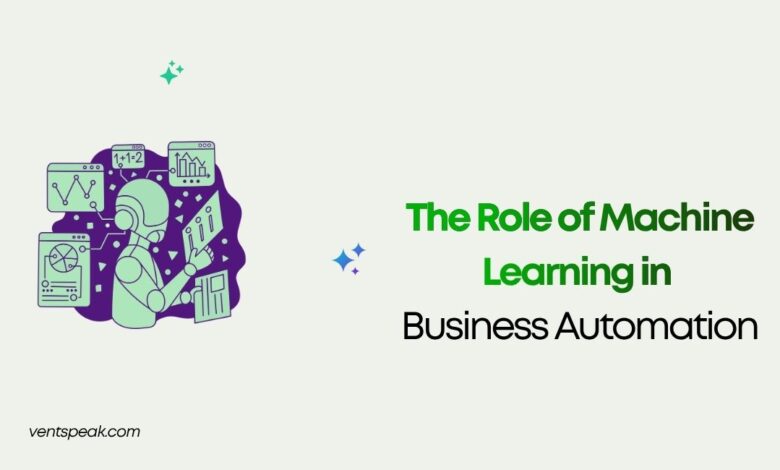
Enter Machine Learning. As the foundational engine driving modern enterprise intelligence, machine learning has transitioned business automation from rigid, rule-based execution into fluid, cognitive orchestration. Instead of merely executing instructions, systems now interpret data, recognize complex patterns, learn from historical outcomes, and make autonomous operational decisions.
In 2026, integrating Machine Learning into your operations is no longer an experimental luxury—it is the core infrastructure required to scale enterprise efficiency, mitigate risk, and achieve hyperautomation.
How Machine Learning Transforms Business Automation
Machine Learning upgrades traditional business automation by replacing rigid, hard-coded rules with predictive data models. By processing unstructured data, recognizing patterns, and continuously learning from feedback loops, machine learning allows automation systems to handle operational variability, make real-time decisions, and orchestrate end-to-end workflows without constant human rebuilding.
The Shift From Rule-Based Automation to Intelligent Orchestration
To understand the profound impact of Machine Learning on corporate workflows, it is essential to analyze how it redefines the fundamental mechanics of software automation.
Traditional automation, often powered by basic RPA, acts as the “hands” of an enterprise. It copies, pastes, and types across disconnected software interfaces perfectly—provided nothing changes. However, it is entirely blind. It cannot read the sentiment of an incoming customer complaint, nor can it detect an anomaly in an enterprise supply chain unless a human explicitly wrote a rule for that exact scenario.
Machine Learning introduces the “brain.” By training algorithms on massive volumes of historical enterprise data, businesses can automate judgment-based steps. When a machine learning model is layered on top of automation pipelines, the system gains the ability to process unstructured data (like legal contracts, audio logs, and free-form emails), predict the best next course of action, and dynamically route tasks based on contextual understanding.
Core Applications of Machine Learning in Business Processes
The commercial viability of a machine learning framework spans across every critical corporate department. When applied directly to workflow automation, it unlocks highly specialized operational capabilities:
1. Intelligent Document Processing (IDP)
Enterprises are swimming in unstructured physical and digital paperwork—invoices, shipping manifests, receipts, and regulatory filings. Traditional optical character recognition (OCR) frequently fails when formatting changes. Machine learning-driven IDP uses natural language processing (NLP) and computer vision to understand documents contextually. It extracts line items, validates tax data, and flags discrepancies automatically, reducing document workflow costs by up to 70%.
2. Predictive Supply Chain and Inventory Automation
A major challenge in logistics is balancing supply with unpredictable market demand. Machine learning models analyze thousands of concurrent variables—historical sales data, macroeconomic indicators, weather forecasts, and geopolitical shipping delays—to autonomously adjust inventory reorder points, optimize warehouse spacing, and predict equipment failures before they cause operational downtime.
3. Hyper-Personalized Customer Operations
Modern support ticket routing has moved far beyond basic keyword matching. Machine learning algorithms analyze incoming customer communications to gauge real-time emotional sentiment, assess account churn risk, and instantly determine intent. The system can then either resolve the issue entirely via an autonomous AI agent or route it to a specialized human tier with a drafted, context-aware solution.
4. Automated Financial Forecasting and Fraud Detection
In corporate finance, machine learning algorithms continuously review thousands of real-time transactions to spot statistical anomalies that bypass legacy rule-based compliance systems. Simultaneously, these data models automate rolling revenue forecasts, allowing executive teams to adjust departmental budgets dynamically based on predictive market performance.
Strategic Comparison: RPA vs. Machine Learning Automation
| Operational Capability | Traditional Rule-Based RPA | Machine Learning-Driven Automation |
| Data Requirements | Highly structured data (CSV, SQL tables) | Unstructured data (PDFs, Audio, Free-form text) |
| Handling of Exceptions | Fails immediately; triggers manual support | Resolves minor variances; routes complex anomalies |
| System Evolution | Requires manual recoding when software changes | Self-corrects and improves via continuous feedback |
| Decision-Making Ability | Binary execution (True/False based on strict rules) | Probabilistic estimation (Calculates best next action) |
| Primary Use Case | Bulk data entry, form copying, report downloads | Fraud analysis, predictive maintenance, sentiment routing |
Key Performance Indicators (KPIs) for ML Automation
Deploying Machine Learning within your business requires a disciplined approach to tracking performance. Organizations must build their optimization frameworks around four primary metrics:
- Straight-Through Processing (STP) Rate: The percentage of workflows that are initiated, processed, and completed entirely by the machine learning system without requiring a human operator to resolve an exception.
- Model Drift and Accuracy Degradation: A metric tracking how well a machine learning model performs over time as real-world data evolves. Left unmonitored, real-world changes cause accuracy to decay, requiring scheduled retraining loops.
- Time-to-Resolution (TTR): The total clock time saved from the moment a business event occurs (e.g., an incoming insurance claim) to its final, automated resolution.
- Cost Per Automated Transaction: The total capital required to compute, host, and maintain the machine learning model compared to the legacy operational expense of manual processing.
2026 Trends Redefining Machine Learning in Enterprise Workflows
As we progress through 2026, several structural shifts are redefining how Machine Learning executes corporate automation:
- The Proliferation of Agentic AI: The enterprise landscape has moved from single-task bots to autonomous multi-agent networks. Machine learning models now act as orchestrators, allowing specialized AI agents to collaborate dynamically. One agent reads an enterprise inquiry, a second queries a secure vector database, a third updates the internal CRM, and a fourth reviews the system’s own work for quality control.
- The Model Context Protocol (MCP) Standard: Integration bottlenecks have historically strangled advanced automation rollouts. The emergence of MCP as a universal connectivity standard allows machine learning models to securely plug into databases, SaaS stacks, and legacy software with a single connection architecture, drastically reducing deployment times.
- Widespread Hyperautomation Ecosystems: Leading enterprises are no longer looking for isolated software wins. They are actively utilizing machine learning to stitch together process mining, predictive analytics, and automated decision-making layers into comprehensive, self-healing operational loops.
Read More: Top CRM SaaS Platforms for Scaling Startups
The Ultimate Blueprint to AI Automation and SaaS Technologies
The Future of SaaS: Emerging Trends and Technologies in 2026
7 SaaS Security Best Practices: How AI Strengthens Cloud Application Protection
Frequently Asked Questions (FAQs)
Conclusion
The integration of Machine Learning has fundamentally shifted the boundaries of corporate capability. By stepping past the structural bottlenecks of legacy, rule-based software, machine learning gives modern automation systems the intelligence required to analyze data contextually, tolerate systemic variance, and make high-stakes operational choices in real time.
As autonomous multi-agent systems and unified connectivity standards like MCP continue to scale throughout 2026, the competitive divide will widen between organizations running static operations and those powered by self-improving, intelligent automation. The mandate for modern enterprise leaders is clear: map your workflow bottlenecks, eliminate data silos, and embed predictive models into your execution layer to build an agile, cognitive organization.
What is the role of machine learning in business automation?
Machine learning introduces cognitive reasoning to automation systems. By replacing static rules with trained data models, it enables software pipelines to interpret unstructured data, handle operational variability, predict business outcomes, and make independent choices.
How does machine learning differ from standard RPA?
Standard RPA acts as a digital worker following strict, hard-coded rules that break when data formats change. Machine learning acts as an analytical mind, identifying patterns within data variance and continuously adapting its behavior based on feedback loops.
What are the main challenges when implementing machine learning in workflows?
The primary challenges include managing data silos, avoiding model drift (where real-world changes lower algorithm accuracy), overcoming integration bottlenecks, and ensuring proper AI governance and explainability for regulated industries.
Can machine learning automate unstructured data processing?
Yes. Through specialized branches like natural language processing (NLP) and computer vision, machine learning systems can accurately read, categorize, and extract critical business information from unstructured sources like emails, PDF contracts, and voice memos.
What is hyperautomation in modern business?
Hyperautomation is an enterprise strategy that combines machine learning, artificial intelligence, process mining, and RPA to orchestrate, analyze, and automate end-to-end operational processes across an entire organization.