
AI automation and SaaS technologies in 2026 represent a combined market force projected to surpass $465 billion globally. Businesses leveraging AI-powered SaaS workflows achieve up to 5.8x ROI within 14 months, with 88% of enterprises now deploying AI automation in at least one core function. The blueprint for success requires aligning scalable cloud infrastructure, intelligent workflow automation, and agentic AI capabilities across operations.
Introduction: Why AI Automation + SaaS Is the Business Backbone of 2026
We are living through the most significant shift in how businesses operate since the invention of the internet. AI automation is no longer a futuristic concept or a luxury reserved for Fortune 500 companies — it is now the operating standard. And at the center of this revolution sits SaaS (Software as a Service): the delivery engine that makes intelligent automation accessible, scalable, and cost-effective for organizations of every size.
In 2026, the question is no longer whether your business should integrate AI automation and SaaS technologies — it is how fast you can do it before competitors make your manual processes obsolete.
Consider this: the AI automation market crossed $169.46 billion in 2026, with 88% of enterprises deploying AI automation in at least one function. The global AI SaaS market is on a trajectory to reach $775.44 billion by 2031 at a 38.28% CAGR. Meanwhile, companies that have fully operationalized AI automation report a staggering 5.8x average ROI within just 14 months.
This is not hype. This is documented transformation — backed by McKinsey, Gartner, Deloitte, Forrester, and IDC.
This guide is your ultimate blueprint: a comprehensive, data-driven roadmap to understanding, implementing, and scaling AI automation and SaaS technologies that will future-proof your business in 2026 and beyond.
What Is AI Automation in SaaS? A Clear Definition
AI automation in SaaS refers to the integration of artificial intelligence technologies — including machine learning, natural language processing (NLP), large language models (LLMs), and agentic AI — into cloud-delivered software platforms to autonomously execute business processes, decisions, and workflows with minimal human intervention.
Unlike traditional automation (which follows rigid, rule-based scripts), AI-powered business automation is adaptive. It learns from data, improves over time, handles exceptions intelligently, and scales dynamically based on workload.
Key Components of AI Automation in SaaS
- Machine Learning (ML) Engines — Predictive analytics, anomaly detection, recommendation systems
- Natural Language Processing (NLP) — Intelligent chatbots, document analysis, sentiment analysis
- Robotic Process Automation (RPA) + AI — Smart bots that handle structured and unstructured data
- Agentic AI — Autonomous AI agents that plan, execute, and iterate on multi-step business tasks
- Generative AI Integration — LLM-powered content creation, code generation, and customer interaction
- AI Workflow Orchestration — Connecting tools, triggering actions, and managing cross-platform automations
AI Automation vs. Traditional Automation: What’s the Difference?
| Dimension | Traditional Automation | AI-Powered SaaS Automation |
| Logic Type | Rule-based, rigid scripts | Adaptive, learns from data |
| Error Handling | Breaks on exceptions | Handles edge cases intelligently |
| Decision Making | Binary (if/then) | Probabilistic, context-aware |
| Data Types Supported | Structured only | Structured + unstructured (text, voice, images) |
| Scalability | Manual configuration required | Auto-scales with demand |
| Integration Capability | Limited API support | Native multi-platform AI orchestration |
| ROI Timeline | 12–24 months | 3–14 months |
| Example Tools | Legacy macros, basic RPA | Zapier AI, Make, n8n, Microsoft Copilot |
Pro Insight: The shift from traditional automation to AI-powered SaaS automation is not merely a technology upgrade — it is a fundamental redesign of how work flows through your organization.
The Market Opportunity: Numbers That Demand Attention
Understanding the scale of the AI automation and SaaS market is essential before building any strategic blueprint. These figures — drawn from the world’s leading research institutions — paint an undeniable picture of where business technology is heading.
AI Automation Market Statistics (2026)
- The AI automation market reached $169.46 billion in 2026 (Orbilon/IDC)
- 88% of enterprises now use AI automation in at least one business function
- 97% of executives report their company deployed AI agents in the past 12 months
- Companies deploying AI automation report a 5.8x average ROI within 14 months
- AI customer service automation leads adoption at 56%, handling 30% of interactions at $0.50–$0.70/conversation vs. $6–$8 for human agents
SaaS Market Statistics (2026)
- The global SaaS market is expected to reach $375–$465 billion in 2026 (Fortune Business Insights / Precedence Research)
- AI SaaS market is growing at a 38.28% CAGR, from $71.54B in 2023 to $775.44B by 2031
- 92% of SaaS companies plan to increase AI integration in their products in 2025–2026
- 81% of organizations have automated at least one business process using SaaS applications
- North America’s SaaS market will hit $211.7 billion by 2026, holding a 46% global market share
Agentic AI: The Next Wave
- Agentic AI spending is projected to exceed 26% of worldwide IT spending over the next 5 years, reaching $1.3 trillion by 2029 (IDC)
- 33% of organizations with 1,000+ employees have already deployed agentic AI by late 2025
- 40% of enterprise applications will embed AI agents by end of 2026 (Gartner)
- The global population of actively deployed AI agents is expected to surpass 1 billion by 2029 — a 40x increase over 2025 levels (Deloitte/IDC)
Core Pillars of AI-Powered SaaS Architecture
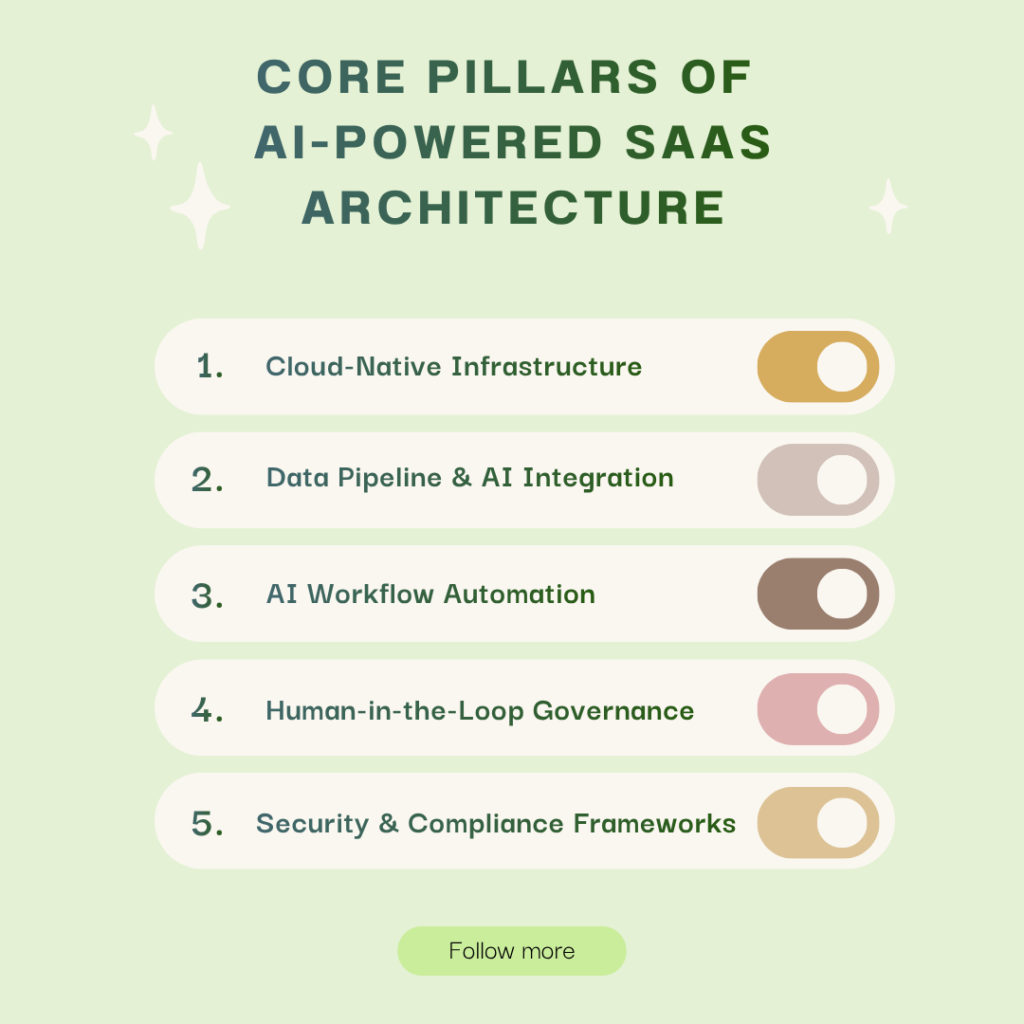
Building a scalable, future-proof AI automation stack requires understanding the foundational layers upon which successful systems are constructed. Think of this as your technical blueprint for AI-powered SaaS architecture.
Pillar 1: Cloud-Native Infrastructure
AI automation at scale demands cloud-native deployment. This means microservices architecture, containerization (Docker/Kubernetes), and serverless functions that scale automatically based on demand. Platforms like AWS, Google Cloud, and Azure now offer native AI services — from managed ML models to pre-built automation APIs — that dramatically reduce time-to-deployment.
Best Practice: Adopt a multi-cloud or hybrid-cloud strategy to avoid vendor lock-in and ensure business continuity.
Pillar 2: Data Pipeline & AI Model Integration
AI automation is only as powerful as the data feeding it. A robust ETL (Extract, Transform, Load) pipeline — combined with real-time data streaming — ensures your AI models have access to clean, current, and relevant data for decision-making.
Key components include:
- Data lakes (raw storage) + data warehouses (structured analytics)
- Real-time event streaming via Kafka, AWS Kinesis, or Confluent
- Vector databases (Pinecone, Weaviate) for LLM-powered semantic search
Pillar 3: AI Workflow Orchestration Layer
The orchestration layer is where the intelligence lives. Tools like n8n, Make (formerly Integromat), Zapier AI, and Microsoft Power Automate act as the central nervous system — connecting disparate SaaS tools, triggering AI models, and managing conditional logic across automated workflows.
Pillar 4: Human-in-the-Loop (HITL) Governance
Despite the power of autonomous AI, governance and oversight remain critical. Only 6% of companies fully trust AI agents to autonomously execute core business processes without human review. Effective HITL systems define clear escalation paths, audit trails, and intervention thresholds — balancing speed with accountability.
Pillar 5: Security, Compliance, and Data Privacy
With 55% of employees adopting SaaS applications without security involvement, and shadow AI risks growing rapidly, a zero-trust security model integrated with AI governance frameworks is non-negotiable. This includes role-based access control (RBAC), data encryption at rest and in transit, SOC 2 compliance, and AI ethics policies aligned with the EU AI Act.
Top AI Automation Use Cases Across Business Functions
AI automation is not a single solution — it is a cross-functional capability that delivers measurable ROI across every department. Here is how leading organizations are deploying it in 2026.
1. Customer Service & Support Automation (56% Adoption)
AI-powered customer service is the most widely adopted automation use case globally. Virtual agents handle 30% of customer interactions today, projected to reach 50% by 2027. The economics are compelling: AI handles conversations at $0.50–$0.70 each versus $6–$8 for human agents.
Real-World Example: Intercom’s AI agent “Fin” resolves over 50% of support tickets autonomously, reducing first-response time by 80% for SaaS companies like Deel and Loom.
Key Tools: Intercom AI, Zendesk AI, Freshdesk Freddy AI, Salesforce Einstein
2. Marketing Automation & Personalization (48% Adoption)
AI-driven marketing platforms automate lead scoring, email personalization, campaign optimization, and content generation. Agentic AI in marketing can autonomously A/B test campaigns, reallocate ad budgets in real time, and generate personalized copy at scale.
Real-World Example: HubSpot’s AI Content Assistant generates personalized email sequences that achieve 2.3x higher open rates compared to generic broadcasts, based on behavioral segmentation.
Key Tools: HubSpot AI, Marketo Engage, Jasper AI, Copy.ai, ActiveCampaign AI
3. IT Operations & DevOps Automation (51% Adoption)
AI in IT operations (AIOps) reduces alert fatigue, accelerates incident response, and predicts infrastructure failures before they occur. Organizations using AI in IT ops report 31% fewer critical incidents and 28% faster mean time to resolution (MTTR).
Real-World Example: Datadog’s AI-powered monitoring platform automatically correlates alerts, identifies root causes, and suggests remediation steps — cutting incident resolution time from hours to minutes.
Key Tools: Datadog AI, PagerDuty AIOps, Dynatrace Davis AI, New Relic AI
4. Finance & Accounts Automation
AI automates invoice processing, expense categorization, fraud detection, and financial forecasting. Companies using AI in finance report 70–80% reduction in manual data entry and up to 40% improvement in cash flow forecasting accuracy.
Key Tools: Tipalti, Brex AI, Ramp Intelligence, QuickBooks AI, Chargebee
5. HR & Talent Acquisition Automation
From AI-powered resume screening to automated onboarding workflows and predictive employee retention modeling, HR SaaS platforms now deliver end-to-end talent lifecycle automation. AI reduces time-to-hire by up to 40% and cuts recruiter workload by 60%.
Key Tools: Workday AI, Greenhouse, Lever, Eightfold AI, Rippling
6. Sales Automation & Revenue Intelligence
AI sales tools analyze deal health, predict churn, recommend next-best actions, and automate outreach sequences. Companies using AI in sales see 10–15% revenue lift and 20–30% productivity improvements per sales rep.
Key Tools: Salesforce Einstein, Gong.io, Clari, Apollo.io AI, Outreach AI
AI Workflow Automation: A Step-by-Step Implementation Blueprint
Building an AI-powered automation system from scratch requires a structured, phased approach. Rushing to automate without strategic clarity is the #1 reason implementations fail. Here is a proven six-phase blueprint.
Phase 1: Process Discovery & Prioritization (Week 1–2)
Before automating anything, map your current processes. Identify tasks that are:
- High-volume and repetitive
- Rule-based or pattern-driven
- Time-sensitive but low-complexity
- Prone to human error
Use tools like Miro, Lucidchart, or ProcessMaker to create visual process maps. Prioritize automations with the highest effort-savings and lowest implementation risk using an Impact vs. Effort Matrix.
Phase 2: Data Readiness Assessment (Week 2–3)
AI automation requires clean, accessible, and structured data. Audit your existing data infrastructure:
- Are data sources integrated or siloed?
- Is data formatted consistently across systems?
- Do you have sufficient historical data to train or fine-tune models?
Address data quality gaps before launching automation workflows.
Phase 3: Tool Selection & Architecture Design (Week 3–4)
Select your automation stack based on your process requirements, existing tech ecosystem, and team capabilities. Key decisions include:
- Automation orchestrator (n8n, Make, Zapier AI, or enterprise-grade like Microsoft Power Platform)
- AI models (OpenAI GPT-4o, Claude 3.5, Gemini 1.5, or domain-specific fine-tuned models)
- Integration layer (native APIs, middleware, or iPaaS solutions)
Phase 4: Pilot Deployment & Testing (Week 4–6)
Launch your first automation in a sandboxed environment. Select a high-impact, moderate-complexity workflow for your pilot. Define clear success metrics: time saved, error rate reduction, cost per transaction, and user satisfaction.
Run parallel testing — human and AI handling the same process simultaneously — to validate accuracy before full deployment.
Phase 5: Scale & Optimize (Month 2–4)
Expand automation across the identified process map. Implement monitoring dashboards to track KPIs in real time. Use AI model feedback loops to continuously improve accuracy. Establish governance checkpoints for human review of edge cases.
Phase 6: Continuous Improvement & Innovation (Ongoing)
AI automation is not a one-time project — it is an evolving capability. Schedule quarterly reviews to:
- Identify new automation opportunities
- Retrain AI models on updated data
- Integrate new SaaS tools and APIs
- Align automation roadmap with business strategy
Read more blog : Web Hosting and Server Management: The Complete Guide (2026 Edition)
Top AI Automation & SaaS Tools Comparison (2026)
Choosing the right AI automation and SaaS platform is a business-critical decision. The table below provides a structured comparison of the leading platforms across six key evaluation dimensions to help you make an informed choice.
AI Automation & SaaS Platform Comparison Table (2026)
| Platform | Category | AI Capabilities | Integration Count | Best For | Starting Price | G2 Rating |
| Zapier AI | Workflow Automation | GPT-4o powered Zaps, AI Actions, natural language triggers | 7,000+ apps | SMBs, no-code teams | $19.99/mo | 4.5/5 |
| Make (Integromat) | Visual Automation | AI modules, HTTP/API builder, multi-step AI flows | 1,500+ apps | Mid-market, complex workflows | $9/mo | 4.7/5 |
| n8n | Open-Source Automation | LLM nodes, AI agent workflows, self-hostable | 400+ native | Developers, enterprises | $24/mo (cloud) | 4.8/5 |
| Microsoft Power Automate | Enterprise Automation | Copilot AI, Azure AI, process advisor | 1,000+ connectors | Microsoft 365 orgs | $15/user/mo | 4.3/5 |
| HubSpot AI | CRM + Marketing | AI content, predictive lead scoring, chatbots | 1,500+ apps | Marketing & sales teams | $45/mo (Starter) | 4.4/5 |
| Salesforce Einstein | CRM + Revenue AI | Predictive analytics, Einstein GPT, Agentforce | 3,000+ via AppExchange | Enterprise sales orgs | Custom pricing | 4.2/5 |
| Intercom AI (Fin) | Customer Support | Autonomous AI agent, resolution tracking, escalation | 300+ apps | SaaS customer success | $74/mo (Starter) | 4.5/5 |
| Workday AI | HR + Finance | Predictive hiring, workforce planning, expense AI | Enterprise only | Large enterprises (500+) | Custom pricing | 4.1/5 |
| Jasper AI | Content Generation | Brand voice AI, multi-format generation, SEO mode | 80+ integrations | Content & marketing teams | $49/mo | 4.3/5 |
| Datadog AI | IT Observability | AIOps, root cause analysis, anomaly detection | 700+ integrations | DevOps, IT Ops teams | $15/host/mo | 4.3/5 |
Note: Pricing as of May 2026. Ratings sourced from G2.com. Verify current pricing on vendor websites.
How We Evaluate AI Automation and SaaS Platforms
Our editorial team applies a rigorous, multi-dimensional evaluation framework when assessing AI automation and SaaS platforms. Below are the seven criteria that guide every recommendation in this guide.
Evaluation Criteria
1. Innovation & AI Depth (Weight: 20%) We assess the sophistication of a platform’s AI capabilities — not merely whether AI features exist, but whether they are deeply integrated, continuously updated, and genuinely transformative. Platforms leveraging frontier LLMs, agentic workflows, and proprietary model training score highest.
2. Scalability & Performance (Weight: 18%) A platform must grow with your business without degrading performance. We evaluate auto-scaling infrastructure, API rate limits, data throughput capabilities, multi-region deployment support, and documented case studies of enterprise-scale deployments.
3. Ease of Integration (Weight: 16%) The number of native integrations, the quality of API documentation, the availability of pre-built connectors, and the effort required to connect existing tools are all factored into this score. Platforms with robust iPaaS capabilities and open API standards score higher.
4. Automation Capabilities (Weight: 18%) We evaluate the breadth and depth of automation: trigger types, conditional logic complexity, multi-step workflow capacity, error handling, and support for AI-driven decision nodes. Agentic AI capabilities that enable autonomous multi-step task execution receive additional weight.
5. User Experience & Onboarding (Weight: 12%) Even powerful platforms fail if users cannot adopt them. We evaluate UI/UX quality, learning curve, quality of documentation, availability of templates, and onboarding support resources — including AI-assisted setup features.
6. Pricing & Value Transparency (Weight: 10%) We analyze pricing models critically — including hidden costs at scale, per-seat vs. usage-based economics, AI feature paywalls, and total cost of ownership. Transparent, predictable pricing models score higher.
7. Customer Reviews & Industry Relevance (Weight: 6%) Verified user feedback from G2, Capterra, and Gartner Peer Insights, combined with the platform’s relevance to specific industry verticals and use cases, rounds out the evaluation. Long-term customer retention rates are also considered.
Scalable SaaS Systems: Building for Growth from Day One
One of the most common — and costly — mistakes in SaaS and automation architecture is building systems that work today but break under growth pressure. Scalability is not a feature you add later — it is a design philosophy you embed from the start.
Architectural Principles for Scalable AI SaaS
Microservices Over Monoliths: Break your application into independently deployable services. Each function (authentication, billing, AI inference, notifications) operates as a separate service that can be scaled individually based on demand. This prevents the “all or nothing” scaling problem of monolithic architectures.
Event-Driven Design: Use event streaming platforms (Apache Kafka, AWS EventBridge, Google Pub/Sub) to decouple services and enable asynchronous processing. This architecture supports millions of events per second and allows AI models to react to business events in near real time.
API-First Strategy: Build every capability as an API before building any UI around it. API-first companies grow 2.4x faster than product-first peers. This enables third-party integrations, partner ecosystems, and AI agent access to core capabilities.
Multi-Tenant Architecture: Design your SaaS platform to serve multiple customers from a single infrastructure instance while maintaining data isolation. This is the backbone of cost-efficient scaling — infrastructure costs grow logarithmically rather than linearly.
AI Inference Optimization: As you scale AI features, inference costs can spiral. Implement caching for common AI responses, use smaller fine-tuned models for specific tasks (rather than frontier LLMs for everything), and implement request batching to optimize GPU utilization.
SaaS Pricing Models Aligned with Scalable Growth
The shift toward usage-based and outcome-based pricing is one of the defining SaaS trends of 2026. Gartner forecasts that 40% of SaaS spend will shift to usage/outcome pricing by 2030. Understanding which model fits your platform is critical:
- Per-Seat Pricing — Predictable, simple, but faces pressure from AI agent proliferation (agents don’t have “seats”)
- Usage-Based Pricing — Aligns cost with value delivered; favored by AI-heavy platforms
- Outcome-Based Pricing — Emerging model; charges based on measurable business results (e.g., tickets resolved, revenue generated)
- Freemium + AI Upsell — Low barrier to entry with AI features as premium tier driver
Future Technology Trends Shaping AI and SaaS in 2026 and Beyond
The AI automation and SaaS landscape is evolving at a pace that demands continuous strategic attention. These are the five most important technology trends shaping the industry over the next 12–36 months.
Trend 1: Agentic AI Takes Center Stage
The transition from AI as a tool to AI as an autonomous agent is the most transformative shift currently underway. Agentic AI systems plan, reason, use tools, and execute multi-step workflows without human prompting for each step. Deloitte projects the agentic AI market to grow from $8.5 billion in 2026 to $45 billion by 2030 at a 53% CAGR. By 2029, IDC forecasts over 1 billion actively deployed AI agents globally.
Business Implication: Organizations will need to develop AI agent governance frameworks, define agent personas and permissions, and redesign workflows around human-agent collaboration models.
Trend 2: The Rise of Vertical SaaS + AI Specialization
Horizontal SaaS platforms are facing increasing competition from industry-specific vertical SaaS solutions that combine deep domain knowledge with AI capabilities. Vertical SaaS is the fastest-growing segment, driven by demand for industry-tailored AI. Healthcare SaaS, legal tech, construction tech, and agri-tech are seeing 2x growth rates compared to horizontal platforms.
Business Implication: If you operate in a specific industry vertical, purpose-built AI SaaS tools will outperform generic platforms on both accuracy and ROI.
Trend 3: The Model Context Protocol (MCP) and AI Interoperability
MCP is emerging as the universal standard for AI connectivity in 2026. It enables AI agents to securely connect to any data source, API, or tool with standardized authentication and governance. The MCP ecosystem is growing rapidly with OAuth 2.1 enterprise authentication and horizontal scaling support on the roadmap.
Business Implication: SaaS platforms without MCP compatibility risk being excluded from enterprise AI agent workflows. Vendors are racing to become MCP-compatible.
Trend 4: AI-Native Pricing and FinOps for SaaS
As AI becomes embedded in every SaaS platform, token consumption and AI usage costs are becoming significant budget line items. Gartner forecasts enterprise software spend rising at 14.7% in 2026 to more than $1.4 trillion, with generative AI as the primary accelerant. Organizations that fail to implement AI FinOps — tracking AI feature usage, cost per interaction, and ROI by function — will face significant budget overruns.
Business Implication: Establish AI cost governance policies, implement usage monitoring dashboards, and negotiate AI feature pricing commitments with vendors before scaling.
Trend 5: Generative AI + Automation Convergence
The merger of generative AI content capabilities with workflow automation is creating an entirely new category: generative automation. Platforms like n8n, Make, and Zapier are integrating LLM nodes directly into workflows, enabling AI-generated outputs to trigger downstream automated actions. This unlocks use cases like automated research-to-report pipelines, AI-generated and auto-published content, and self-healing code deployments.
Business Implication: Early adopters of generative automation are achieving 10–30x productivity multipliers in content, development, and operations — creating compounding competitive advantages.
Conclusion: Your Competitive Edge Starts Here
The convergence of AI automation and SaaS technologies in 2026 represents the most significant operational leverage opportunity in modern business history. The data is unambiguous: a $169+ billion automation market, 88% enterprise adoption, 5.8x ROI within 14 months, and a trajectory toward 1 billion AI agents deployed globally by 2029.
The businesses winning in this landscape share a common blueprint:
- They treat AI automation as a core operational strategy — not a side project
- They build on scalable SaaS infrastructure designed for growth from day one
- They apply governance and oversight to balance speed with accountability
- They invest in continuous learning — both in their AI models and their teams
- They move fast on agentic AI — recognizing that the era of “AI as a feature” is ending and the era of “AI as an autonomous operator” has begun
The transition will not be seamless. Trust gaps, governance challenges, rising AI costs, and the complexity of multi-system integration will create friction. But for organizations willing to commit to the blueprint — discover, design, pilot, scale, and iterate — the compounding advantages will be enormous.
The ultimate question for your business is not whether AI automation and SaaS technologies belong in your strategy. It is whether you are building that strategy fast enough.
The future belongs to the organizations that automate intelligently. Start now.
Frequently Asked Questions (FAQ)
Q1: What is the difference between AI automation and traditional business automation?
Traditional automation follows rigid, pre-programmed rules and breaks when encountering unexpected inputs or exceptions. AI automation, by contrast, uses machine learning and language models to understand context, handle unstructured data, make probabilistic decisions, and continuously improve through feedback loops. The key differentiator is adaptability — AI automation evolves; traditional automation does not.
Q2: What are the best AI automation tools for small businesses in 2026?
For small businesses, the most accessible and cost-effective AI automation tools include Zapier AI (best for no-code workflow automation across 7,000+ apps), Make (best for complex multi-step automations with a visual builder), HubSpot AI (best for marketing + CRM automation), and Intercom Fin (best for AI-powered customer support). These platforms offer generous free tiers or low-cost entry plans and require no engineering expertise to get started.
Q3: How long does it take to implement AI automation in a business?
The timeline varies by complexity. Simple workflow automations (e.g., email routing, lead capture, invoice processing) can be implemented in 1–2 weeks. Mid-complexity deployments across a single department typically take 4–8 weeks. Enterprise-wide AI automation programs spanning multiple departments and custom AI model integration typically require 3–6 months for initial deployment, with continuous iteration thereafter.
Q4: What ROI can businesses expect from AI automation and SaaS integration?
According to data from McKinsey, Gartner, and Deloitte, companies that fully operationalize AI automation report a 5.8x average ROI within 14 months. Customer service automation delivers the fastest payback — AI handles interactions at $0.50–$0.70 versus $6–$8 for human agents. IT operations automation reduces critical incidents by 31% and cuts mean time to resolution by 28%. Marketing automation drives 10–20% revenue lift for companies deploying AI-powered personalization.
Q5: Is AI automation going to replace human jobs?
The evidence strongly suggests AI automation transforms jobs rather than eliminates them at scale. 76% of leaders agree that AI will automate specific tasks but will not entirely replace roles. The highest-risk functions are repetitive, rule-based tasks (data entry, basic reporting, routine customer queries). The fastest-growing roles are those requiring AI oversight, workflow design, data interpretation, and strategic judgment — skills that are increasingly in demand as organizations scale their automation programs.