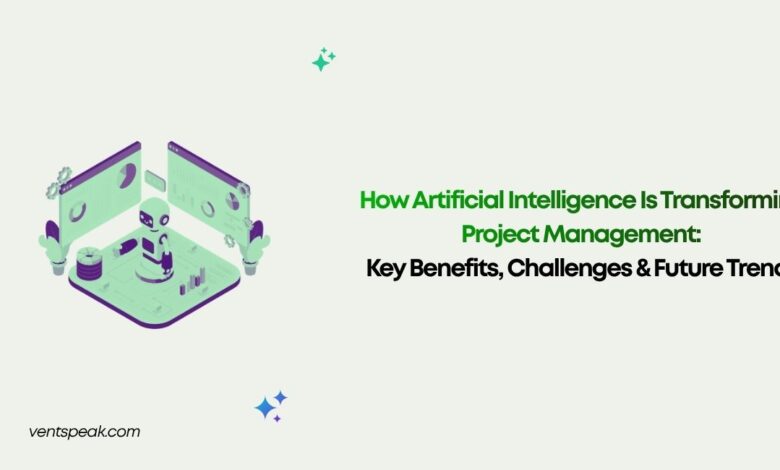
How Artificial Intelligence Is Transforming Project Management: Key Benefits, Challenges & Future Trends

The modern workplace moves at a breakneck pace. Between cross-functional deliverables, remote team coordination, and rapidly tight deadlines, enterprise project management has outgrown static spreadsheets and manual tracking. Enter Artificial Intelligence in Project Management.
AI is completely changing how organizations plan, track, and complete enterprise initiatives. By shifting management from a reactive state to a highly predictive one, machine learning algorithms and advanced automation are redefining project success rates worldwide.
How Is AI Changing Project Management?
Artificial Intelligence in Project Management automates administrative overhead, predicts project bottlenecks before they occur, optimizes human resource allocation, and updates workflows in real time. Rather than replacing human professionals, modern AI project management tools act as predictive co-pilots. They convert raw historical data into strategic insights, allowing teams to focus on creative problem-solving and higher-value tasks.
Key Benefits of Implementing AI in Project Management
Deploying AI in Project Management changes delivery from guesswork to data-backed science. Organizations moving to intelligent tooling see massive lifts across execution metrics.
1. Advanced Predictive Analytics and Accurate Forecasting
Traditional project forecasting depends heavily on gut feelings or basic historic averages. Machine learning models analyze thousands of past data points—including historical task duration, scope creep markers, and team velocity—to predict final completion windows and budget changes with staggering accuracy.
2. Intelligent Resource Allocation
Over-allocation leads to employee burnout, while under-allocation kills profitability. Intelligent tools look across active pipelines, analyze team skill matrices, monitor real-time workloads, and instantly assign tasks to the best-suited individuals without human bias.
3. Automated Administrative Workflows
Project managers often spend up to half their week on low-value administrative work like chasing down updates, logging hours, and creating status slides. Automation routines handle these tasks seamlessly, moving data smoothly between systems and triggering reminders automatically when milestones slip. Learn more about optimizing enterprise systems in our guide to SaaS trends driving modern business technology.
Traditional vs. AI-Driven Project Management
The shift toward intelligent infrastructure represents a core change in everyday operations:
| Feature/Capability | Traditional Project Management | AI-Driven Project Management |
| Data Utilization | Historical logs used strictly for retrospective reviews | Real-time stream analysis used for active forecasting |
| Risk Handling | Reactive resolution after issues occur | Proactive mitigation based on anomaly tracking |
| Task Delegation | Manual scheduling based on static calendars | Dynamic task routing optimized by skill and current load |
| Reporting Method | Weekly compiled slide decks and manual spreadsheets | Continuous live dashboards updated via natural language processing |
Core Challenges and Risks of AI Adoption
While the potential upside is immense, organizations must navigate serious challenges when deploying automated solutions.
- Data Silos and Poor Quality: Machine learning systems require clean, centralized data. If historical inputs are fractured across separate emails, chat logs, and localized documents, the resulting algorithmic forecasts will fail.
- The ‘Black Box’ Trust Gap: If an algorithm predicts a critical milestone will fail but can’t explain why, stakeholders often dismiss the warning. Balancing algorithmic complexity with clear explainability is crucial. Read about fixing platform silos in our breakdown of enterprise workflow automation frameworks.
- Adoption Friction and Reskilling: Teams often fear that automation means down-sizing. Overcoming resistance requires framing these applications as productivity enhancers rather than human replacements.
Interactive AI Value & Time Savings Calculator
To help visualize how integrating intelligent tools directly impacts your operational bottom line, use this calculator to estimate hours reclaimed and monthly cost reductions:
Read More Blogs: 10 Best AI Tools in 2026 : The Ultimate Guide
15 Best Free AI Tools in 2026: A Full Guide
11 Best Free AI Tools for Small Businesses
A Step-by-Step Strategy for Integrating AI Tools
Moving your PMO (Project Management Office) into an intelligence-first workflow requires a phased approach to protect operational stability.
1.Centralize and Clean Project Data:Phase 1: Foundation.
Consolidate disparate data sources from chat applications, email threads, and localized spreadsheets into a unified project repository to train models accurately.
2.Identify Core Automation Candidates:Phase 2: Discovery.
Audit workflows to isolate high-frequency, low-variance administrative friction points such as daily status chasing or routine card migration.
3.Run Focused Pilot Software Evaluations:Phase 3: Validation.
Deploy specific AI project management tools within a single cross-functional team for 30 to 60 days to test usability, integration accuracy, and adoption rates.
4.Establish Governance and Scaling Frameworks:Phase 4: Expansion.
Train broader team directories on prompt styling, document generation compliance, and algorithm risk flags before rolling out system-wide access.
For additional tips on optimizing operations during digital shifts, check out our insights on leveraging productivity tools for scaling businesses.
Future Trends: The Next Horizon of Project Intelligence
Looking deeper into the horizon, Project Management AI is evolving past basic automated assistants into deeply integrated collaborative agents.
- Conversational PM Interfaces: Natural language processing will let stakeholders request complex pipeline reviews, modify dependencies, or run cost-benefit models simply by chatting with their infrastructure.
- Advanced Sentiment and Team Health Analysis: Future systems will responsibly analyze communication patterns to flag impending team burnout or slipping collaboration metrics before friction impacts delivery.
- Autonomous Resource Re-Balancing: Rather than simply alerting a manager to an issue, upcoming agents will securely adjust cross-project timelines and source open internal skill resources autonomously. Explore managing decentralized teams successfully in our blueprint for hybrid and remote team management.
Conclusion
Embracing Artificial Intelligence in Project Management is no longer a luxury for early adopters; it is a necessity for maintaining a competitive operational edge. By offloading administrative burdens to specialized automation engines and leveraging predictive forecasting, organizations dramatically lower execution risks while freeing up human talent to focus on innovation and strategic growth.
Frequently Asked Questions (FAQs)
1. Will AI completely replace human project managers?
No. AI is designed to automate manual tasks and offer predictive insights. It lacks the critical human empathy, negotiation skills, emotional intelligence, and strategic stakeholder management required to lead complex teams successfully.
2. What are the best AI project management tools available today?
Top options include platforms like Asana, Monday.com, ClickUp, and Celoxis, which feature embedded machine learning engines that handle automated resource management, risk predictions, and generative status documentation.
3. How does AI improve risk management in enterprise tracking?
AI constantly scans active workflows to catch early warning signs, such as consecutive missed internal milestones or shifting resource availability. It then surfaces automated alerts and suggests alternate schedules before a delay occurs.
4. Is corporate data safe when using generative AI tools?
Data safety depends heavily on platform configuration. Enterprise-grade systems protect sensitive operational data by ensuring internal logs are never used to train public foundational language models.
5. What is the first step to implement AI in an existing PMO?
The first step is auditing and cleaning your existing project documentation. AI engines need reliable, centralized historical data to produce accurate timelines and cost forecasts.