Subscription Business Model Explained: How It Works, Types, and Benefits in 2026

The way businesses exchange value with consumers has permanently shifted. Buying a product once and owning it forever is increasingly becoming an exception. Instead, we live in an on-demand, value-on-tap economy. At the very center of this transformation is the subscription business model.
Whether you are streaming digital entertainment, relying on enterprise AI workflows, or getting custom-tailored vitamins delivered to your doorstep, subscriptions dictate how we consume products. In fact, data shows that the global subscription economy market size is projected to grow from $623.61 billion in 2025 to $738.82 billion in 2026, expanding at an impressive compound annual growth rate (CAGR) of 18.5%.
For modern enterprises, B2B SaaS firms, and e-commerce brands, moving toward a subscription based business model isn’t just an option for boosting sales—it is a mandatory framework for survival, long-term stability, and compounding growth.
What is a Subscription Business Model?
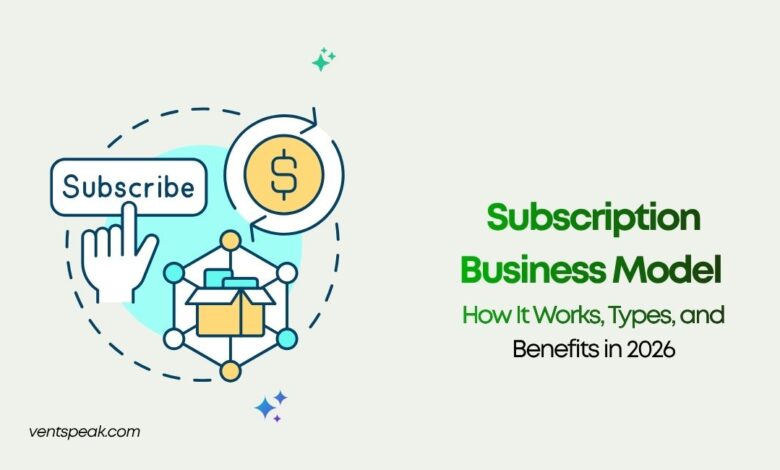
A subscription business model is a recurring revenue strategy where customers pay a set fee at regular intervals (weekly, monthly, or annually) for continuous access to a product or service, rather than making a one-time upfront purchase.
Under a subscription model, the transaction is not a single point of sale; it is an ongoing contractual relationship. If the customer stops paying, their access to the asset, platform, or physical delivery terminates. This structure shifts the corporate focus from purely acquiring new buyers to consistently retaining and driving value for existing subscribers.
How the Subscription Business Model Works
The operational mechanics of a successful subscription business model rely on a continuous, cyclical relationship between vendor and customer. Rather than a linear sales funnel, the subscription framework operates as an active lifecycle loop built on automation, convenience, and predictive data.
To function seamlessly, the operational structure requires several core components:
- Automated Recurring Billing: Businesses utilize advanced billing engines (like Stripe, Zuora, or Recurly) to charge a user’s saved payment method automatically each cycle, completely eliminating manual billing friction.
- Tiered Feature Access: Instead of a one-size-fits-all product, access is split into distinct pricing tiers. Customers choose a tier based on consumption volume, user seats, or advanced feature sets.
- The Continuous Value Loop: Because cancellation is often just a click away, businesses must consistently update their product offerings, fix bugs, and supply fresh content or materials to keep the value of the payment apparent.
- Data-Driven Lifecycle Management: Companies rigorously track user behavior and engagement analytics to predict churn indicators, trigger automated win-back campaigns, and surface targeted cross-selling opportunities.
Types of Subscription Business Models with 2026 Examples
As the subscription economy matures, businesses are moving away from rigid, unyielding pricing structures. In 2026, the marketplace is defined by four core variations of the subscription business model:
1. Software-as-a-Service (SaaS) and Digital Access
Instead of purchasing software licenses via massive upfront capital expenditures, users pay a monthly or annual fee to access applications hosted entirely in the cloud.
- 2026 Real-World Examples: Adobe Creative Cloud, Microsoft 365, Salesforce, and enterprise Generative AI platforms.
- Market Insight: The global SaaS sector alone has surpassed $307 billion, demonstrating how critical cloud access is to enterprise operations.
2. Curation and E-Commerce Box Subscriptions
This model delivers physical products directly to a consumer’s home on a set schedule. The primary allure is a mix of ultimate convenience and personalized discovery.
- 2026 Real-World Examples: Dollar Shave Club (consumables), HelloFresh (meal kits), and BarkBox (pet supplies).
- Market Insight: Hyper-personalized nutrition and health subscriptions—such as customized vitamin packs mixed via online diagnostic quizzes—are expanding significantly, with users retaining up to 2.5 times longer when personalization is built directly into the onboarding workflow.
3. Content and Media Streaming Subscriptions
Users pay a fixed recurring fee for unlimited access to a massive, centralized digital library of video, audio, or text content.
- 2026 Real-World Examples: Netflix, Spotify, Disney+, and premium media networks.
- Market Insight: The digital media streaming market is highly saturated. As a result, leading platforms have shifted their primary focus away from raw subscriber growth and toward maximizing the Average Revenue Per Member (ARM) using ad-supported hybrid tiers and exclusive add-ons.
4. Usage-Based and Hybrid Subscriptions
A rapidly expanding framework where users pay a foundational base fee to access a platform, combined with fluctuating, variable charges determined by actual consumption (e.g., data processed, storage used, or API calls executed).
- 2026 Real-World Examples: Snowflake, Amazon Web Services (AWS), and modern AI development infrastructures.
The Strategic Benefits of the Subscription Model
Transitioning to a subscription model delivers fundamental, compounding advantages for both the operating business and the end consumer.
Why Businesses Prefer Subscriptions
- Unrivaled Revenue Predictability: Knowing your Monthly Recurring Revenue (MRR) and Annual Recurring Revenue (ARR) allows executive teams to forecast cash flows, schedule inventory cycles, and allocate R&D budgets with absolute precision.
- Compounding Customer Lifetime Value (LTV): When a business eliminates manual re-purchasing loops, long-term customer relationships naturally deepen, allowing the total revenue generated from a single account to multiply far beyond an initial transactional sale.
- Lower Customer Acquisition Costs (CAC): By offering low-friction entry barriers like free trials, freemium access tiers, or affordable starter plans, companies can convert casual browsers into paying users much faster.
- Invaluable First-Party Usage Data: Continuous product usage gives companies direct visibility into exactly how their customers interact with their software or service, guiding intelligent product development and automated customer success initiatives.
Why Customers Prefer Subscriptions
- Affordability and Lower Upfront Barriers: Paying a modest monthly fee is far easier on a household budget or corporate capital expenditure sheet than shelling out thousands of dollars on day one.
- Immediate Out-of-the-Box Value: Subscriptions shift the burdens of software maintenance, server updates, security patching, and product curation entirely onto the vendor. The user simply enjoys a product that improves automatically over time.
- Ultimate Flexibility and Autonomy: Modern consumers demand control. The ability to seamlessly upgrade, downscale, pause, or cancel a plan at any time matches the fluid needs of modern businesses and consumers.
Traditional vs. Subscription Business Models
| Core Strategic Metric | Traditional Transactional Model | Subscription Business Model (2026) |
| Primary Revenue Driver | One-time upfront purchases | Compounding recurring revenue (MRR/ARR) |
| Primary Financial Focus | Profit margin per unit sold | Customer Lifetime Value (LTV) vs. CAC |
| Customer Retention Focus | Low / Fragmented re-marketing loops | Critical / Continuous lifecycle engagement |
| Product Value Delivery | Static at point of sale | Dynamic via continuous updates & upgrades |
| Pricing Elasticity | Fixed sticker prices | Flexible tiers, usage-based, & hybrid options |
| Inventory & Resource Planning | Reactive based on seasonal trends | Predictive based on highly visible active contracts |
Critical Metrics for Subscription Success
To successfully manage and scale a subscription model, you must build your data infrastructure around four vital, non-negotiable performance benchmarks:
Monthly Recurring Revenue (MRR) / Annual Recurring Revenue (ARR)
The predictable, normalized revenue your business expects to receive every single month or year. It is the core metric used to measure the health, velocity, and baseline valuation of a recurring-revenue business.
Customer Acquisition Cost (CAC)
The cumulative sales, marketing, and onboarding spend required to win a single new subscriber. For a business to remain profitable, CAC must be systematically recovered within a fraction of the user’s expected lifespan.
Customer Lifetime Value (LTV)
The total net revenue a business expects to generate from a single customer account throughout their entire lifecycle.
Churn Rate
The percentage of your total subscriber base that cancels or fails to renew their subscriptions over a given timeframe. High churn acts as a leaky bucket, completely wiping out any growth achieved by your marketing teams.
The Golden Ratio of Subscriptions: A healthy, scaling subscription enterprise should consistently maintain an LTV:CAC ratio of 3:1 or greater, meaning the value of a customer must be at least triple the cost spent to acquire them.
Read More blogs: Top CRM SaaS Platforms for Scaling Startups
The Ultimate Blueprint to AI Automation and SaaS Technologies
The Future of SaaS: Emerging Trends and Technologies in 2026
7 SaaS Security Best Practices: How AI Strengthens Cloud Application Protection
Emerging Trends Redefining Subscriptions
The subscription landscape has transitioned well beyond its initial novelty phase. Success now requires navigating several structural economic and technological shifts:
- The Rise of Agentic AI: Artificial Intelligence has transitioned from a backend analytic tool into an active, functional infrastructure. In 2026, roughly 40% of scaling subscription businesses rely on specialized AI models for proactive revenue recovery, predictive churn mapping, and smart billing retry logic. Simultaneously, consumer comfort with AI managing their personal subscription portfolios has climbed to 43%.
- The Power of the “Pause”: Consumers are hyper-intentional about their digital spending and actively prune underutilized services. In response, modern subscription platforms are replacing strict cancellation paths with flexible “pause before cancel” configurations. Merchants deploying intelligent pause options have experienced a massive 337% year-over-year surge in pause usage, with data revealing that 3 out of 4 consumers who pause eventually return to active, paid status.
- Micro-Subscriptions: To capture highly cost-conscious buyers who resist long-term commitments, brands are leveraging ultra-low-cost micro-subscriptions for bite-sized, temporary access. These micro-plans serve as highly effective activation funnels, successfully converting 13% of single-transaction buyers into long-term, premium recurring contracts.
Frequently Asked Questions (FAQs)
What is a subscription business model?
A subscription business model is an ongoing revenue strategy where customers pay a recurring fee at predetermined intervals (such as monthly or annually) to maintain uninterrupted access to a specific product, digital platform, or physical service.
How do subscription business models handle customer churn?
Subscription companies mitigate churn by utilizing predictive AI analytics to spot drop-offs in user engagement, engineering smooth “pause-before-cancel” options, offering localized alternative payment methods, and launching targeted automated win-back campaigns directed at past subscribers.
Why is the subscription model superior to traditional one-time sales?
The subscription framework provides businesses with highly predictable, compounding revenue streams, reduces cash flow volatility, and significantly drives up Customer Lifetime Value (LTV) by building deep, ongoing customer relationships rather than isolated transactions.
What are the main types of subscription models?
The four dominant variations include Software-as-a-Service (SaaS) and digital access, curation and e-commerce product boxes, digital media streaming libraries, and consumption-driven usage-based or hybrid billing structures.
What is a healthy LTV to CAC ratio for a subscription startup?
A generally accepted industry benchmark for a thriving, sustainable subscription business is an LTV:CAC ratio of 3:1 or higher, meaning the total lifetime revenue generated by an account must comfortably triple the capital spent to acquire them.