
Marketing operations have grown increasingly complex. Teams juggle dozens of channels, navigate strict privacy updates, and try to make sense of fragmented data silos. Analysts spend roughly 60% to 70% of their time simply cleaning and formatting spreadsheets rather than extracting actual business value.
Deploying ai powered marketing analytics shifts the paradigm from manual data preparation to autonomous insight generation. By automating data ingestion, using predictive machine learning models, and offering natural language interfaces, modern marketing teams eliminate the guesswork and scale their operational performance efficiently.
How Does AI-Powered Marketing Analytics Solve Modern Marketing Challenges?
AI-powered marketing analytics unifies fragmented multi-channel data, automates data cleansing, and applies predictive machine learning models to solve data silo, attribution, and manual reporting challenges. Instead of waiting days for custom data engineering pipelines, teams can use natural language processing to query unified datasets, identify real-time performance anomalies, and receive predictive budget optimization recommendations in seconds.
The Core Challenges of Modern Marketing Operations
Modern marketing strategies require managing a fragile web of consumer data. The explosion of independent digital channels has created complex friction points that legacy business intelligence (BI) systems struggle to resolve.
1. Data Silos and Disconnected Tooling
The typical mid-market or enterprise organization utilizes multiple independent platforms across search, paid social, programmatic video, customer relationship management (CRM), and email outreach. Because each platform operates inside its own walled garden with unique naming conventions, metrics, and API schemas, tracking cross-channel performance requires massive data wrangling.
2. The Death of Third-Party Cookies and Privacy Regulations
Stricter privacy rules, regional regulations, and browser restrictions have fundamentally broken traditional multi-touch attribution models. Marketers can no longer rely on deterministic tracking pixels to map an uninterrupted user path from first impression to closed-won revenue.
3. Delays in Manual Reporting Architectures
When performance data relies on manual extraction and transformation, reports are outdated the moment they are compiled. Teams operating on weekly or monthly batch reporting cycles fail to catch creative ad fatigue, budget pacing overspends, or technical tracking anomalies until the budget has already been exhausted.
What Is AI-Powered Marketing Analytics?
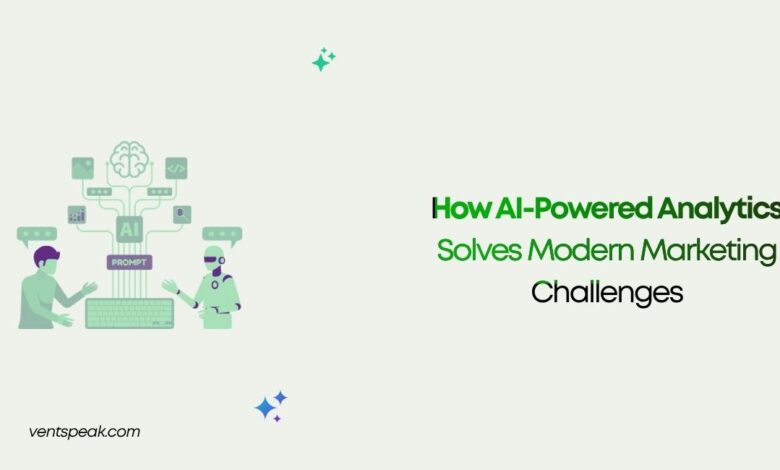
AI powered marketing analytics refers to the application of machine learning (ML), natural language processing (NLP), and autonomous agentic workflows to marketing datasets. The core goal is to extract deep, actionable ai marketing insights without requiring ongoing human data-engineering pipelines.
Rather than replacing human oversight, this technology acts as an operational multiplier. It shifts the analyst’s role from writing boilerplate SQL queries or building fragile dashboards to validating models, pressure-testing hypotheses, and executing strategic business decisions.
4 Pillars of AI Marketing Analytics Tools
To deliver enterprise-grade value, modern ai marketing analytics tools rely on four foundational technological pillars.
1. Automated Data Integration and Cleansing
The quality of any artificial intelligence model depends on the integrity of its data foundation. Advanced analytics engines automate data ingestion across hundreds of platforms. They ingest, clean, and normalize disparate fields into unified metrics—ensuring the underlying models evaluate standardized, reliable information.
2. Predictive Analytics and Forecasting
Predictive engines apply machine learning models to historical performance patterns to forecast future acquisition trends. Marketers use these predictive frameworks to model customer lifetime value (LTV), score incoming leads based on conversion probability, and run advanced marketing mix modeling (MMM) to simulate budget shifts before committing spend.
3. Real-Time Anomaly Detection
AI infrastructure continuously monitors performance streams to flag statistical anomalies. If a tracking tag breaks, a social ad campaign experiences an immediate cost-per-click (CPC) spike, or a budget pacing rule is violated, the system sends immediate notifications to mitigate financial risk.
4. Natural Language Querying (Conversational Analytics)
By integrating custom large language models (LLMs) with organized database schemas, conversational analytics allows users to interface with complex marketing data using plain language.
- User Prompt: “Show me the top 5 campaigns by ROAS across Meta and Google Ads last quarter, broken down by country.”
- AI Action: Translates the plain text query into structured SQL, queries the data warehouse, and outputs a formatted data visualization in real time.
Comparing Traditional BI vs. AI-Powered Marketing Analysis
| Capability Feature | Traditional Marketing Analytics (Legacy BI) | AI-Powered Marketing Analysis |
| Data Ingestion & Transformation | Manual ETL pipelines, rigid data modeling, high engineering dependencies. | Automated ingestion, no-code data transformations, autonomous schema mapping. |
| Speed to Insight | Delayed batch reporting (weekly or monthly retrospectives). | Real-time dashboards, automated alerts, and instant conversational queries. |
| Primary Method | Descriptive analytics (focuses on what happened in the past). | Predictive and prescriptive analytics (forecasts future performance). |
| Data Governance | Manual spreadsheet checks, error-prone naming conventions. | Machine-learning-driven taxonomy enforcement and validation rules. |
| Attribution Approach | Rule-based click tracking (First-Touch, Last-Touch). | Algorithmic, privacy-compliant attribution modeling and MMM. |
Step-by-Step Guide to Implementing AI Marketing Analytics
Transitioning your team to an ai powered marketing analysis workflow requires a structured, iterative implementation strategy to align data architecture with strategic objectives.
Step 1: Audit Your Current Data Infrastructure
Before adopting any AI tooling, document your active advertising platforms, CRMs, and web analytics portals. Identify variations in metric tracking—such as how different teams define a “qualified lead”—to build an agreed-upon, single source of truth.
Step 2: Establish Centralized Data Aggregation
Unify your fragmented data streams into a centralized data repository or warehouse. Utilize data orchestration platforms that offer automated normalization, which prepares your raw tokens for clean AI training and querying.
Step 3: Run a Low-Risk Pilot Program
Avoid complex, high-stakes overhauls during your initial deployment. Launch a focused pilot program around a specific routine workflow, such as automating your cross-channel weekly performance reporting or setting up predictive lead-scoring models for a single product line.
Step 4: Train Your Team on Data Literacy
Technology alone cannot fix flawed strategic processes. Train your marketing managers and analysts on how to draft structured queries, interpret algorithmic suggestions, and spot hallucinations or logical inconsistencies.
Step 5: Establish Human-in-the-Loop Validation Protocols
Set strict validation rules where human specialists review AI-generated insights, budget reallocations, and strategic recommendations. Maintain a 30-day review buffer to confirm that accuracy thresholds remain above 95% before trusting autonomous workflows.
Read More: Top CRM SaaS Platforms for Scaling Startups
The Ultimate Blueprint to AI Automation and SaaS Technologies
The Future of SaaS: Emerging Trends and Technologies in 2026
7 SaaS Security Best Practices: How AI Strengthens Cloud Application Protection
Best Practices and Mistakes to Avoid
Proven Success Strategies
- Prioritize the Business Case: Select your analytics tools based on specific operational friction points—such as reducing customer acquisition cost (CAC) or speeding up reporting cycles—rather than chasing novel features.
- Enforce Strict Taxonomy Rules: Deploy automated marketing data governance rules to validate UTM structures and campaign naming conventions before they go live on ad networks.
- Account for Total Cost of Ownership (TCO): Budget carefully for hidden implementation costs, including data cleaning, data integration setups, team onboarding hours, and validation cycles.
Pitfalls to Avoid
- Deploying AI Over Broken Data Foundations: Training an LLM or predictive engine on messy, non-normalized spreadsheets will yield confidently incorrect performance insights.
- Treating Analytics as Fully Autonomous Systems: Eliminating human oversight leaves your campaigns exposed to algorithmic errors, model drift, and strategic blind spots.
- Relying on Over-Engineered Custom Dashboards: Avoid building rigid, 50-tab dashboards that quickly become outdated. Aim for core, high-level performance snapshots combined with conversational natural language querying for on-demand exploration.
Driving Measurable Performance Outcomes
Embracing ai marketing analytics resolves the fragmentation, latency, and tracking limitations that challenge modern growth teams. By substituting slow manual pipelines with real-time data cleansing, prescriptive forecasting models, and clear natural language reporting, businesses can unlock deep, strategic insights from their data.
The ultimate value of AI within your marketing stack lies in operational execution. Organizations that invest in clean data infrastructure, build reliable governance rules, and blend automated analysis with human strategic insight will systematically eliminate waste, optimize their customer acquisition costs, and outpace their competition.
What specific reporting bottleneck or data silo is currently slowing down your marketing team’s decision-making?
Frequently Asked Questions (FAQs)
What is the primary benefit of ai marketing analytics?
The primary benefit is the democratization of real-time, cross-channel performance insights. AI automates data aggregation and normalization tasks, allowing marketing teams to query unified performance data instantly via natural language, bypassing technical reporting queues.
How does predictive AI improve multi-channel budget allocation?
Predictive AI analyzes historical campaign data, audience touchpoints, and conversion signals to model future performance across channels. By executing marketing mix modeling (MMM), the system forecasts the financial impact of shifting ad spend before budgets are officially reallocated.
Can conversational AI replace traditional marketing analytics dashboards?
Conversational AI minimizes the need for over-engineered, multi-tab dashboards by answering specific performance questions on demand. However, a balanced approach combines a centralized high-level dashboard for everyday metrics with an AI conversational agent for deep-dive exploratory questions.
How do data governance rules protect marketing budgets from AI errors?
Automated data governance systems enforce campaign naming taxonomies, validate UTM structures, and monitor real-time spend parameters. This foundational layer ensures that AI models analyze accurate data while preventing budget overspends caused by tracking errors.
What data infrastructure is needed to support AI marketing insights?
To generate accurate insights, AI engines require clean data pipelines that pull directly from marketing platform APIs into a centralized repository. The data infrastructure must normalize varied metric tracking and maintain clean schemas across all active channels.