How to Automate Repetitive Tasks with AI in 2026: AI Agents vs Traditional Automation

As modern businesses race to eliminate operational friction, the debate between AI agents vs traditional automation has taken center stage. For over a decade, companies relied on rigid scripts, macros, and basic Robotic Process Automation (RPA) to handle repetitive tasks. Today, the rapid maturation of generative models and autonomous systems has completely transformed what is possible.
Understanding how to leverage AI automation effectively requires looking beyond simple script execution. Organizations are shifting toward intelligent automation that adapts to unstructured data, makes real-time decisions, and learns continuously.
What is the Difference?
Traditional automation relies on rigid, rule-based scripts (if/then logic) that break when faced with unexpected inputs or unstructured data. In contrast, AI agents are autonomous software entities powered by large language models (LLMs) that can reason, plan, execute multi-step workflows, and handle unexpected exceptions dynamically without human intervention.
Understanding the Paradigm Shift: AI Agents vs Traditional Automation
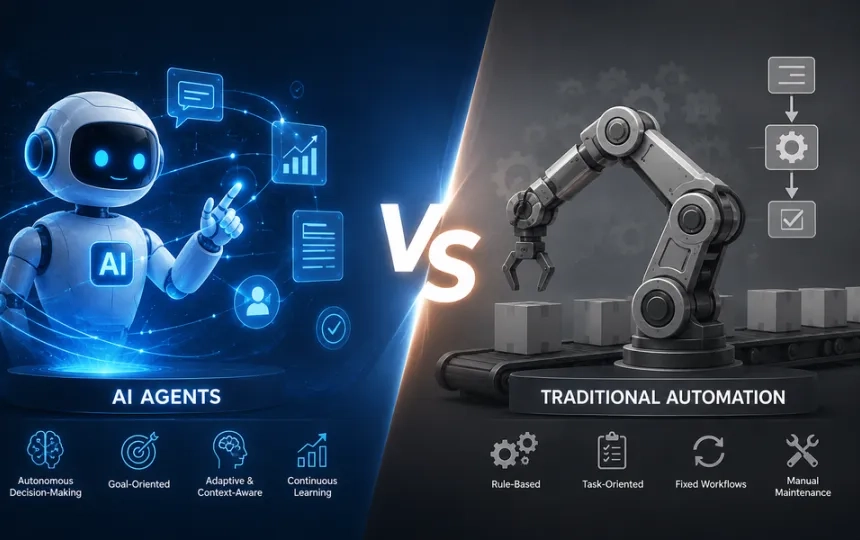
To optimize business operations in 2026, leaders must evaluate how workflows handle change. The core divergence between legacy workflows and modern systems lies in how they process logic and data.
What is Traditional Automation?
Traditional automation, including classic RPA and macro scripts, executes exact instructions programmed by developers. It excels at deterministic, high-volume, structured tasks like moving data from a standardized web form into an internal database. However, if a data field changes format or an unexpected error occurs, the process halts immediately, requiring manual intervention.
What is the Role of AI Agents?
AI agents represent the frontier of AI-powered automation. Rather than following a static flowchart, an AI agent receives a high-level objective (e.g., “Audit incoming vendor invoices, cross-reference them with delivery logs, and flag discrepancies”). The agent independently determines the steps required, uses APIs, processes unstructured PDFs or emails, and resolves discrepancies autonomously.
For a comprehensive look at how these technologies intersect with cloud software, review this ultimate blueprint for AI automation and SaaS technologies.
Core Differences: A Head-to-Head Comparison Table
| Feature | Traditional Automation | AI Agents & Intelligent Automation |
| Logic Type | Rigid, rule-based (If/Then statements) | Probabilistic, adaptive, and reasoning-driven |
| Data Handling | Structured data only (spreadsheets, SQL databases) | Structured and unstructured data (text, voice, images, emails) |
| Exception Handling | Fails or throws an error when exceptions occur | Dynamically troubleshoots and adapts to edge cases |
| Deployment Speed | Weeks or months of custom coding and mapping | Rapid deployment via natural language setup and APIs |
| Maintenance | High ongoing maintenance whenever UI or schemas change | Self-healing capabilities driven by semantic contextual awareness |
How AI-Powered Automation Transforms Core Business Operations
Implementing AI automation successfully touches every department, moving organizations from reactive task management to proactive execution.
Customer Support and Engagement
Legacy automated chatbots relied on strict decision trees that frequently frustrated users with repetitive loops. Modern intelligent systems use contextual memory to resolve complex tier-2 support tickets, process refunds based on sentiment analysis, and draft personalized customer responses instantly.
Financial Operations and Invoicing
Finance teams waste hundreds of hours manually matching receipts, purchase orders, and invoices. By deploying autonomous agents alongside low-code vs. no-code automation platforms, companies can ingest varying invoice layouts from multiple vendors, validate tax IDs, and clear payments without human bottlenecks.
Software Development and Quality Assurance
Engineering squads use autonomous coding assistants to run unit tests, detect bugs in real-time code commits, and document software libraries, freeing up developer hours for core product innovation.
Best Practices for Implementing Intelligent Automation
Transitioning from legacy scripts to autonomous workflows requires careful architectural planning. Follow these best practices to maximize your return on investment:
- Audit Your Current Processes: Map out existing operational bottlenecks before selecting a platform. Ensure you are not automating a broken or poorly defined workflow.
- Adopt a Human-in-the-Loop (HITL) Framework: During initial rollouts, configure system checkpoints where human operators review high-risk or low-confidence decisions.
- Prioritize Data Hygiene: AI models thrive on clean, accessible data. Centralize your data pipelines before introducing autonomous agents.
- Leverage Scalable Infrastructure: Integrate your automation stack with modern cloud collaboration tools to ensure distributed teams stay aligned.
Common Mistakes to Avoid
Even with advanced technology, projects can falter if mismanaged. Watch out for these pitfalls:
- Ignoring Total Cost of Ownership (TCO): Failing to budget for high-volume LLM API consumption fees, ongoing cloud hosting, and model maintenance.
- Prematurely Removing Human Oversight: Trusting an unvetted agent entirely from day one, which can lead to compounding silent errors or hallucinations.
- Neglecting Change Management: Failing to train internal staff, leading to employee resistance or workarounds that create shadow IT vulnerabilities. For more insights, check out these common reasons why AI automation projects fail.
Future Trends and Developments
As we look deeper into 2026 and beyond, automation is shifting from standalone applications to multi-agent ecosystems. Key developments include:
- Collaborative Multi-Agent Networks: Specialized agents (e.g., a marketing agent collaborating directly with a data analysis agent) executing complex corporate campaigns autonomously.
- Natural Language Orchestration: Users building enterprise-grade automations simply by typing descriptive commands in plain language.
- Edge AI Integration: Running lightweight automation models locally on secure corporate devices for zero-latency data processing.
Related Articles
- Why AI Automation Projects Fail & How to Ensure Success
- The Ultimate Blueprint to AI Automation & SaaS Technologies in 2026
- Low-Code vs No-Code Platforms: Which is Better for Automation?
- Cloud Collaboration Tools Explained: A Business Guide for 2026
Conclusion
The evolution from rigid macros to sophisticated systems highlights a fundamental truth: modern efficiency depends on adaptability. While traditional automation remains useful for basic, high-volume data movement, AI agents vs traditional automation comparison clearly demonstrates that intelligent agents unlock unprecedented scalability, flexibility, and cost savings. By auditing your workflows, implementing robust human-in-the-loop controls, and choosing the right technology stack, your business can successfully master AI-powered automation to drive sustainable growth throughout 2026 and beyond.
Frequently Asked Questions
What is the main difference between AI agents and traditional automation?
Traditional automation follows rigid, predefined if/then scripts and fails when encountering unexpected data formats. AI agents use cognitive reasoning and machine learning to interpret unstructured data, make contextual decisions, and adapt to changing workflows autonomously.
Can traditional automation and AI agents work together?
Yes. Many modern organizations use traditional workflow engines to handle structured data transfers and trigger AI agents whenever complex exceptions, unstructured text documents, or cognitive decision-making steps are required.
What are the biggest risks of implementing AI automation?
The primary risks include high API token costs, unstructured data silos, hallucinations from unvetted models, and employee resistance due to poor change management strategies.
How do I choose between low-code automation and custom AI agents?
Choose low-code tools for standard, predictable data syncing and standard API connections. Deploy custom AI agents when your workflows require multi-step reasoning, natural language comprehension, and dynamic problem-solving.
Do AI automation tools require a technical background to set up?
While complex enterprise deployments require engineering oversight, modern AI automation platforms feature natural language prompts and intuitive visual builders that allow business operators and citizen developers to create workflows quickly.