
Manual data entry, repetitive task switching, and disconnected software systems drain thousands of productive hours from modern businesses every year. Traditional automation scripts help, but they break down the moment a process deviates from rigid, rule-based logic. Enter AI workflow automation—the next evolutionary step in business efficiency. By combining cloud software with machine learning and large language models (LLMs), organizations can now orchestrate end-to-end tasks that adapt, learn, and execute autonomously.
What Is AI Workflow Automation?
AI workflow automation is the integration of artificial intelligence technologies—such as machine learning, natural language processing, and autonomous agents—into business software tools to execute complex, multi-step tasks without constant human intervention. Unlike basic software macros that follow strict “if/this/then” logic, AI-powered systems can interpret unstructured text, make qualitative decisions, handle workflow exceptions, and optimize operations dynamically.
Understanding AI Workflow Automation and Its Core Benefits
Organizations deploying AI automation workflows move beyond simple administrative scripting. Modern enterprises face vast volumes of unstructured data—customer emails, support tickets, invoices, and market reports—that traditional rules-based tools cannot handle natively.
According to market telemetry outlined in The Ultimate Blueprint to AI Automation and SaaS Technologies, businesses leveraging intelligent workflows achieve up to a 5.8x return on investment within 14 months.
Traditional vs. AI-Powered Automation
- Traditional Automation: Rigid, rule-dependent, prone to breaking on unexpected inputs, and restricted to structured data formats (like database rows).
- AI-Powered Workflow Automation: Flexible, context-aware, capable of parsing messy data, and capable of adjusting actions based on semantic meaning and historical patterns.
Core Components Driving Intelligent Workflow Automation
To build an efficient system, you must understand the technological layers that make workflow automation with AI possible. These components work together to ingest data, process intent, and trigger actions across separate SaaS applications.
1. Large Language Models and Natural Language Processing (NLP)
LLMs act as the cognitive engine of your automation stack. They allow systems to read customer feedback, summarize long documents, or extract specific data points from unstructured PDF invoices. When designing your tool stack, reviewing insights from Claude vs ChatGPT vs Gemini tool comparisons helps determine which model best handles specific text processing or logic generation needs.
2. Event-Driven Triggers and Middleware APIs
APIs (Application Programming Interfaces) bridge your cloud apps. An incoming trigger—such as a new client inquiry filling out a website form—activates an orchestration platform (like Zapier, Make, or custom Python microservices) to route the data through an AI evaluation layer.
3. Vector Databases and Memory Layers
For advanced tasks, systems utilize vector databases to execute semantic searches and retrieve relevant corporate knowledge, ensuring that AI-driven responses remain accurate and grounded in internal company policies.
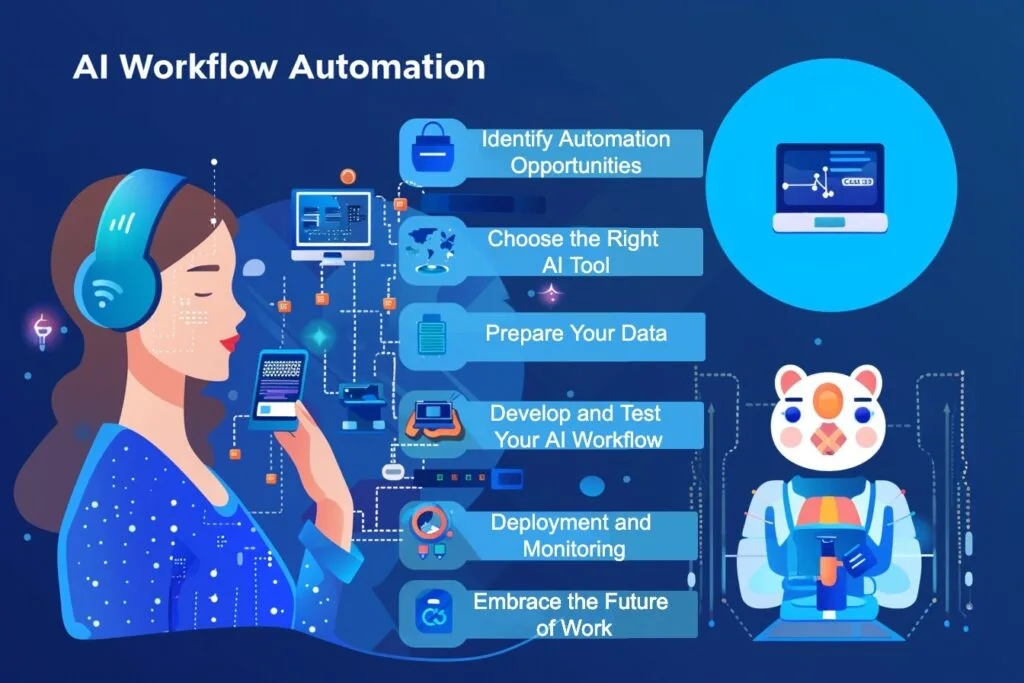
Step-by-Step Guide to Implementing AI Workflow Automation
Deploying intelligent workflow automation does not require an enterprise engineering team if you follow a structured, phased implementation roadmap.
Step 1: Audit and Identify High-Friction Processes
Begin by mapping your organization’s recurring bottlenecks. Ideal candidates for AI-powered workflow automation share these traits:
- High volume and repetitive execution cycles.
- Heavy reliance on handling text, emails, or documents.
- Frequent manual copy-pasting between disparate SaaS applications.
Step 2: Establish Clean Data Pipelines
An automated system is only as reliable as the data it processes. Before connecting your AI models, clean up your historical records, standardize file naming conventions, and unify your data silos to prevent hallucinations or processing errors.
Step 3: Choose Your Orchestration Tool and AI Model
Select a no-code/low-code workflow builder or an API-first developer stack. Connect your chosen LLM endpoint to handle the text-parsing, classification, or decision-making logic required in the middle of your pipeline.
Step 4: Build, Prompt, and Test in a Sandbox Environment
Construct your pipeline step-by-step. Write clear, constraint-driven system prompts for your AI steps. Run test scenarios using edge cases—such as misspelled client inputs or unusually formatted attachments—to verify how the workflow reacts under stress.
Step 5: Implement Human-in-the-Loop (HITL) Oversight
Never cut humans out of critical loops entirely on day one. Set up notification channels (like Slack or Microsoft Teams alerts) where high-stakes decisions—such as outbound financial transactions or sensitive client emails—require a quick manual approval click before final execution.
Traditional Workflows vs. AI-Powered Workflow Automation
| Feature | Traditional Automation | AI-Powered Workflow Automation |
| Logic Handling | Strict “If/Then” conditional statements | Contextual understanding, pattern matching, and reasoning |
| Data Type Support | Structured databases, clean CSVs, and explicit fields | Unstructured text, PDFs, emails, audio transcripts, and images |
| Error Management | Fails completely when encountering unexpected inputs | Dynamically interprets anomalies or flags them for review |
| Adaptability | Requires manual script rewrites when business logic shifts | Learns from historical corrections and adjusts over time |
Best Practices and Common Mistakes to Avoid
Even with advanced technology, poor execution can stall initiatives. Understanding common pitfalls keeps your deployment on track.
- Mistake: Automating a Broken Process. Speeding up an inefficient manual workflow only amplifies errors. Standardize and clean up a process before automating it.
- Mistake: Overlooking Total Cost of Ownership. Failing to monitor API token consumption rates and SaaS subscription fees can lead to unexpected budget inflation.
- Best Practice: Start Small and Scale Horizontally. Launch with a single low-risk workflow—such as automated email categorization or lead routing—before expanding intelligent automation across core enterprise functions. For infrastructure-level scaling, consult AI-driven infrastructure and server management guides to ensure your backend can handle continuous workloads.
- Best Practice: Maintain Rigorous Security Standards. Ensure any data processed by external AI endpoints complies with internal privacy policies and industry regulations
- Related Articles
- The Ultimate Blueprint to AI Automation and SaaS Technologies
- Claude vs ChatGPT vs Gemini: Free AI Tool Comparison
- Why AI Automation Projects Fail: Common Mistakes and Proven Solutions
- How AI Is Transforming Web Hosting & Server Management
Conclusion
Embracing AI workflow automation represents a vital shift from manual administration to scalable operational intelligence. By starting with a clear process audit, maintaining strict data hygiene, and integrating human oversight, beginners can transform rigid procedures into agile, self-optimizing pipelines. As artificial intelligence continues to advance, mastering these foundational workflows ensures your business remains competitive, efficient, and ready for future technological growth.
Frequently Asked Questions (FAQs)
What is the difference between standard automation and AI workflow automation?
Standard automation uses rigid, hardcoded rules to move data between apps. AI workflow automation incorporates machine learning and language models to interpret context, process unstructured data, and make qualitative decisions autonomously.
Do I need coding experience to build AI automation workflows?
No. Modern low-code and no-code orchestration tools (like Zapier, Make, and Retool) allow beginners to connect SaaS apps and trigger AI models using visual drag-and-drop interfaces.
What are the best use cases for AI in workflow automation?
Top use cases include customer support ticket classification, invoice data extraction, automated lead scoring, personalized email drafting, and internal knowledge base search indexing.
How do I prevent AI models from making mistakes in my workflows?
Always implement a Human-in-the-Loop (HITL) verification step for sensitive actions, use tightly constrained system prompts, and reference Why AI Automation Projects Fail to avoid common data hygiene pitfalls.
How much does it typically cost to set up intelligent workflow automation?
Costs vary based on volume. Most no-code platforms feature tiered monthly pricing ranging from $20 to several hundred dollars, supplemented by API consumption fees for LLM calls (often fractions of a cent per prompt).