
As search engines become smarter, the old approach of targeting a single keyword per page is no longer effective. Modern search algorithms—driven by AI platforms, Natural Language Processing (NLP), and semantic search—evaluate content based on topical depth, context, and intent.
To rank consistently across traditional search engines like Google and emerging AI answer engines like ChatGPT, Perplexity, Gemini, and Claude, businesses must adopt keyword clustering.
This comprehensive guide covers what keyword clustering is, why it is critical for modern SEO, Generative Engine Optimization (GEO), and Answer Engine Optimization (AEO), and how you can implement a cluster-based content strategy to dominate search rankings.
What Is Keyword Clustering?
Keyword clustering is the SEO practice of grouping closely related keywords into single, cohesive topics to target with a single web page or content hub. Instead of creating separate pages for minor variations of a phrase, keyword clustering allows you to build comprehensive content that satisfies user intent, builds topical authority, and ranks for hundreds of long-tail variations simultaneously.
Understanding Keyword Clustering in SEO
Keyword clustering in SEO is an advanced strategy where you group search queries with shared search intent, semantic relationships, or overlapping search engine results pages (SERPs).
By organizing keywords into thematic clusters, you shift your content strategy from isolated, single-keyword targeting to holistic topic ownership.
Traditional Keyword Strategy vs. SEO Keyword Clustering
In the early days of search, marketers built individual pages for slight variations of a term (e.g., “best email marketing software” vs. “top email marketing tool”). Today, search engines treat these queries as semantically identical.
| Feature | Traditional Keyword Targeting | SEO Keyword Clustering |
| Strategy Basis | One keyword per page | Multiple related keywords per topic cluster |
| Content Depth | Thin, repetitive, single-focus content | In-depth, authoritative, comprehensive guides |
| Cannibalization Risk | High (multiple pages competing for similar terms) | Low (clear topical structure and intent mapping) |
| Search Performance | Ranks for 1–2 specific terms | Ranks for hundreds of long-tail variations |
| AI Engine Visibility | Low (lacks semantic context for GEO/AEO) | High (rich in entities, structured answers, and intent) |
Why Is Keyword Grouping Essential for Modern SEO, GEO, and AEO?
Implementing a keyword grouping strategy offers distinct advantages for both traditional search engine algorithms and generative AI search platforms.
1. Eliminates Keyword Cannibalization
When you create multiple pages targeting nearly identical terms, search engines struggle to identify which page to rank. Keyword clustering consolidates competing terms into a single, comprehensive page, preventing self-competition.
2. Builds Topical Authority
Search algorithms evaluate websites based on domain expertise. By covering every subtopic, long-tail query, and entity within a keyword cluster, your site signals to search engines that it is a definitive authority on the subject.
3. Enhances AI Engine Optimization (GEO & AEO)
Generative search engines (such as Google AI Overviews, Perplexity, and ChatGPT) generate answers by synthesizing information from authoritative sources. Content structured around keyword clusters provides the semantic context, concise definitions, and entity relationships these engines need to pull direct citations.
4. Improves Internal Linking and Information Architecture
Keyword clusters naturally translate into a pillar-cluster content structure. Pillar pages link outward to supporting cluster content, creating an intuitive structure that helps both users and search crawlers navigate your site efficiently.
Step-by-Step Guide: How to Perform Keyword Clustering
Follow this step-by-step framework to execute keyword research and build effective keyword clusters for your business.
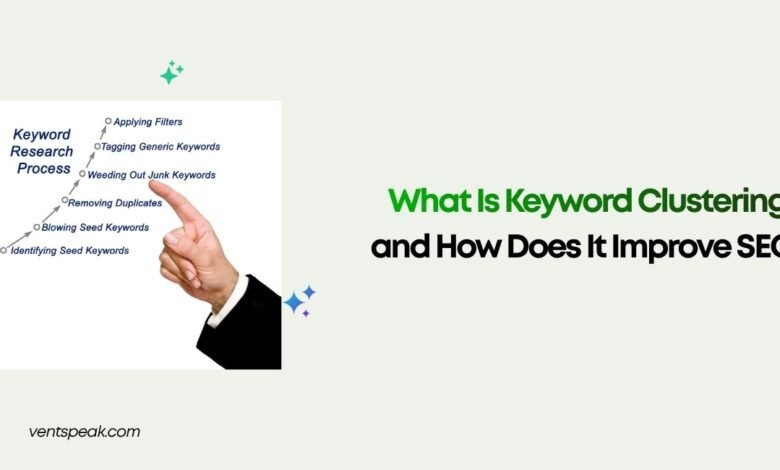
Step 1: Collect a Comprehensive Keyword List
Gather seed keywords, long-tail variations, and competitor terms using tools like Ahrefs, SEMrush, Google Keyword Planner, or Google Search Console. Focus on capturing search queries across all stages of the buyer journey.
Step 2: Group Keywords by SERP Overlap and Intent
Analyze the search engine results pages (SERPs) for your keywords. If two keywords return substantially similar top 10 search results, they belong in the same keyword cluster.
- Informational Cluster: “how to measure ROI”, “calculating marketing ROI”, “marketing ROI formulas”
- Commercial Cluster: “best ROI software”, “top ROI tracking tools”, “ROI software comparison”
Step 3: Identify Your Pillar and Cluster Pages
- Pillar Page: Targets the broad, high-volume head term (e.g., Digital Marketing Strategy).
- Cluster Pages: Target specific subtopics, questions, and long-tail keywords (e.g., Digital Marketing Strategy for B2B, Measuring Digital Marketing Campaign ROI).
Step 4: Map Keywords to Content Assets
Assign each cluster to a specific piece of content. Determine whether an existing page can be updated to cover the cluster or if new content needs to be created.
Read More Blog:
What is Digital marketing — A complete guide 2026
Digital Marketing Fundamentals: Key Concepts, Tools, and Techniques
Digital Marketing Pillar: The Comprehensive Guide 2026: Ai in Digital Marketing
Ethical Challenges of AI in Digital Marketing
Best Practices for Keyword Cluster Optimization
- Integrate Semantic Entities: Include secondary terms, industry terminology, and LSI (Latent Semantic Indexing) terms naturally within H2 and H3 headings.
- Use Concise Answer Blocks: Include 40-to-60-word summary paragraphs under key headings to optimize for Featured Snippets and Google AI Overviews.
- Implement Structured Data: Use Schema markup (e.g., Article, FAQPage) to help search engines parse the relationship between topics.
- Maintain Clear Internal Links: Connect supporting cluster articles to their main pillar page using descriptive anchor text.
Conclusion
Transitioning to a keyword clustering model is essential for modern search performance. By organizing search queries by intent and semantic relationship, you build topical authority, eliminate content cannibalization, and optimize your site for traditional search engines as well as generative AI tools.
Audit your current content, group your raw keyword lists into intent-driven topics, and structure your pages to dominate the modern search landscape.
Frequently Asked Questions (FAQs)
What is the difference between keyword research and keyword clustering?
Keyword research is the process of identifying individual search terms people use. Keyword clustering takes those raw terms and organizes them into logical, intent-based groups to guide your content strategy.
How many keywords should be in a single keyword cluster?
A single cluster can contain anywhere from 5 to over 100 keywords, depending on the topic’s breadth. The key is ensuring every keyword in the cluster shares the same underlying search intent.
Can keyword clustering help with ranking in Google AI Overviews?
Yes. Google AI Overviews rely on understanding entities and semantic context. By grouping related terms into a single, comprehensive piece of content, you provide the structured context required to appear in generative summaries.
How do I know if two keywords should be in the same cluster?
Look at the SERP for both keywords. If 50% or more of the top 10 search results are identical for both queries, those keywords share search intent and should be grouped in the same cluster.