
Choosing the right architecture and target market is the single most critical decision for any software startup or enterprise technology initiative. When evaluating vertical SaaS vs horizontal SaaS founders, product leaders, and investors face a fundamental strategic crossroads: Do you build a broad solution that serves a massive audience across multiple industries, or do you build a laser-focused platform that dominates a single niche?
The modern software landscape is shifting rapidly. With the integration of domain-aware artificial intelligence and autonomous business automation, understanding the operational mechanics of these two SaaS business models is vital for long-term survival and valuation.
Vertical vs. Horizontal SaaS
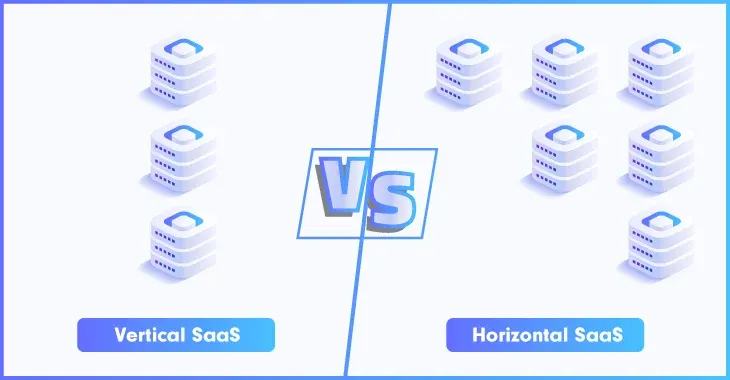
- Horizontal SaaS targets a broad, cross-industry audience by solving universal business functions—such as customer relationship management (CRM), communication, or project management (e.g., Salesforce, Slack, Asana). It wins on total addressable market (TAM) and rapid scalability.
- Vertical SaaS builds purpose-driven software tailored to the unique workflows, compliance mandates, and operational needs of a single industry—such as construction, healthcare, or restaurants (e.g., Procore, Toast, Veeva). It wins on customer retention, high pricing power, and lower customer acquisition costs (CAC).
What is Horizontal SaaS?
Horizontal SaaS refers to cloud software solutions designed to solve specific business processes that span across various industries and verticals. Regardless of whether a company operates in retail, manufacturing, logistics, or finance, the underlying administrative tasks—like tracking leads, balancing books, or messaging team members—remain fundamentally similar.
Common Horizontal Use Cases & Categories
- CRM & Sales: Managing pipelines, tracking customer interactions, and automating outbound sales.
- Communication & Collaboration: Video conferencing, asynchronous messaging, and workspace document sharing.
- Human Resources & Payroll: Managing global talent, employee onboarding, and benefits administration.
- Project & Task Management: Coordinating team sprints, roadmaps, and cross-functional deliverables.
Advantages of Horizontal SaaS
- Massive Total Addressable Market (TAM): Because the product addresses a universal business need, your potential customer base spans nearly every sector of the global economy.
- Simpler Initial Positioning: Explaining what a project management tool or communication app does is straightforward, facilitating broader initial market comprehension.
- Diverse Revenue Streams: You are not tied to the economic health, seasonal downturns, or regulatory shocks of a single industry.
Disadvantages of Horizontal SaaS
- Intense Market Competition: You are often competing against tech giants and thousands of agile startups targeting the exact same generic problem.
- Higher Customer Acquisition Costs (CAC): Standing out in a crowded market requires aggressive marketing spend, heavy brand positioning, and continuous feature expansion.
- Vulnerability to Feature Bloat: Trying to please multiple industries often leads to generalized tools that fail to satisfy power users in any specific sector.
What is Vertical SaaS?
Vertical SaaS (often called industry-specific software) takes a completely opposite approach. Instead of broad functionality for everyone, vertical solutions offer deep, end-to-end operational software built explicitly for a single industry.
These platforms often originate from industry insiders who recognized that off-the-shelf horizontal tools lacked critical features required to handle complex, niche workflows.
Prominent Examples of Vertical SaaS
- Toast: Restaurant management, POS, and online ordering hardware/software integration.
- Procore: Construction project management tailored for general contractors and owners.
- Veeva Systems: Cloud-based software customized strictly for global life sciences and pharmaceutical compliance.
- ServiceTitan: Specialized field service management software for plumbing, HVAC, and electrical contractors.
Advantages of Vertical SaaS
- Lower Customer Acquisition Costs (CAC): Because you are marketing directly to a tightly knit community or professional association, word-of-mouth spreads faster, often resulting in drastically lower acquisition costs.
- Superior Retention and Net Revenue Retention (NRR): Once a vertical platform becomes the core operating system of a business (handling billing, compliance, and daily workflows), churn rates plummet.
- High Pricing Power: Specialized features that save specialized labor hours command premium price points.
Disadvantages of Vertical SaaS
- Finite Market Boundaries: Your growth is inherently capped by the size of the target industry. Scaling past a certain penetration threshold requires expanding into adjacent verticals or international markets.
- Complex Upfront Development: Building software that complies with strict industry regulations requires deep domain expertise, expensive research, and complicated integrations.
Core Differences: Vertical vs. Horizontal SaaS Platforms
To visualize how these two paradigms diverge across key business metrics, review the comparison matrix below:
| Feature / Metric | Horizontal SaaS | Vertical SaaS |
| Target Market | Broad, cross-industry (All businesses) | Narrow, single industry/niche |
| Market Size (TAM) | Exceptionally large | Finite and localized |
| Customer Acquisition Cost (CAC) | Generally higher due to intense market noise | Lower due to targeted, niche marketing |
| Customization & Depth | Surface-level features meant for general utility | Deep, highly specialized workflows and compliance rules |
| Competitive Moat | Brand recognition, integrations, and user experience | High switching costs, embedded workflows, and domain lock-in |
| Expansion Strategy | Geographic expansion and feature upselling | Horizontal expansion into adjacent industries |
The AI Revolution: How Artificial Intelligence is Reshaping Both Models
Artificial intelligence, machine learning, and automation have completely altered the SaaS playbook. In the past, horizontal platforms held an advantage because they could leverage generic AI models (such as broad language assistants or universal analytics). Today, the tide is turning toward domain-aware AI.
- In Horizontal SaaS: AI functions as a productivity enhancer (e.g., summarizing meeting notes, drafting emails, or organizing spreadsheets). While valuable, these features are easily replicated by competitors, compressing profit margins.
- In Vertical SaaS: AI can be trained on proprietary, industry-specific datasets. For instance, a construction vertical SaaS can use AI to predict supply chain bottlenecks based on localized weather patterns and municipal permit data. This creates a powerful, unassailable data moat.
Best Practices and Common Mistakes to Avoid
Whether you are designing a brand-new SaaS software product or pivoting an existing enterprise solution, keep these strategic guidelines in mind.
Best Practices
- Validate Domain Expertise First: If choosing a vertical model, ensure your founding team or key advisors possess real, hands-on experience in that specific sector.
- Design for Integrations: No SaaS platform is an island. Horizontal tools must integrate smoothly with major ERPs, while vertical tools must connect seamlessly with legacy industry hardware and databases.
- Focus on “Systems of Record”: Position your software not just as a tool, but as the foundational system where core business data lives.
Common Mistakes to Avoid
- Falling into Feature Creep: Trying to turn a vertical product into a horizontal utility too early, diluting its core value proposition.
- Underestimating Local Nuances: Assuming that an industry operates the same way globally when local tax codes, labor laws, and compliance standards vary wildly.
- Ignoring Change Management: Selling software to traditional, non-digital industries without investing heavily in customer success and onboarding support.
Related Articles
- Understanding Modern Cloud Architecture for Scalable Platforms
- How AI-Driven Automation is Transforming Enterprise Productivity
- The Ultimate Guide to Reducing Churn in Subscription Business Models
- Building Defensible Moats in Competitive SaaS Markets
Conclusion
The debate between vertical SaaS vs horizontal SaaS is not about finding a universally superior model; it is about matching your business capabilities, capital resources, and strategic vision to the right market dynamics.
If your strength lies in capturing broad, cross-industry markets with a high-volume product, horizontal SaaS offers massive scalability. Conversely, if you possess deep domain expertise and want to build an indispensable, high-retention system with strong pricing power, vertical SaaS provides a clear path to market dominance. Evaluate your strengths, leverage modern AI capabilities, and build a software model engineered for sustainable long-term growth.
Frequently Asked Questions (FAQs)
1. Which SaaS model is easier to scale quickly?
Horizontal SaaS typically scales faster in the early stages because it addresses universal business pain points across an unrestricted total addressable market. However, growth can plateau later due to fierce competition.
2. Why do investors often favor vertical SaaS for long-term retention?
Vertical SaaS applications become deeply embedded in daily industry-specific workflows and regulatory compliance. Because switching costs are exceptionally high and customer acquisition costs are lower, investors value their durable revenue streams.
3. Can a vertical SaaS company eventually transition into a horizontal model?
Yes. Many successful companies start by dominating a tight vertical niche (e.g., scheduling for salons) and then expand horizontally into adjacent service sectors once their brand authority and capital reserves are established.
4. How does AI impact vertical vs. horizontal SaaS differently?
Vertical SaaS leverages domain-specific AI trained on proprietary industry data, creating powerful competitive moats. Horizontal SaaS relies on generalized AI capabilities that are easily commoditized by market competitors.
5. What is “SaaS on top” or PaaS ecosystem extension?
This strategy involves building specialized vertical applications or plugins that sit on top of massive, established horizontal platforms (like Salesforce AppExchange or Shopify App Store), letting startups tap into pre-existing user bases.