

Making healthy habits stick relies on understanding the neuroscience of Healthy habit formation rather than relying solely on fleeting motivation or raw willpower. By breaking down large goals into microscopic actions, anchoring them to existing daily routines (habit stacking), and leveraging environmental design, you reduce cognitive friction. Sustainable behavior change occurs when actions require less mental energy, align with core personal values, and treat setbacks as data rather than failure.
Embarking on a journey to improve your health often begins with a surge of high motivation. You might pledge to wake up an hour earlier, completely overhaul your diet, or exercise every single day. Yet, within a few weeks, life happens: stress creeps in, work gets demanding, and those ambitious routines quietly fade away.
Losing momentum does not mean you lack discipline. Rather, it usually points to a misunderstanding of how habit-building strategies actually function within the human brain. Transitioning from short-lived enthusiasm to permanent healthy lifestyle habits requires working with human psychology, not against it.
The Neuroscience of Habit Formation: Why Willpower Fails
Willpower acts like a finite battery. When you rely exclusively on conscious effort to force a new behavior, you exhaust your mental resources.
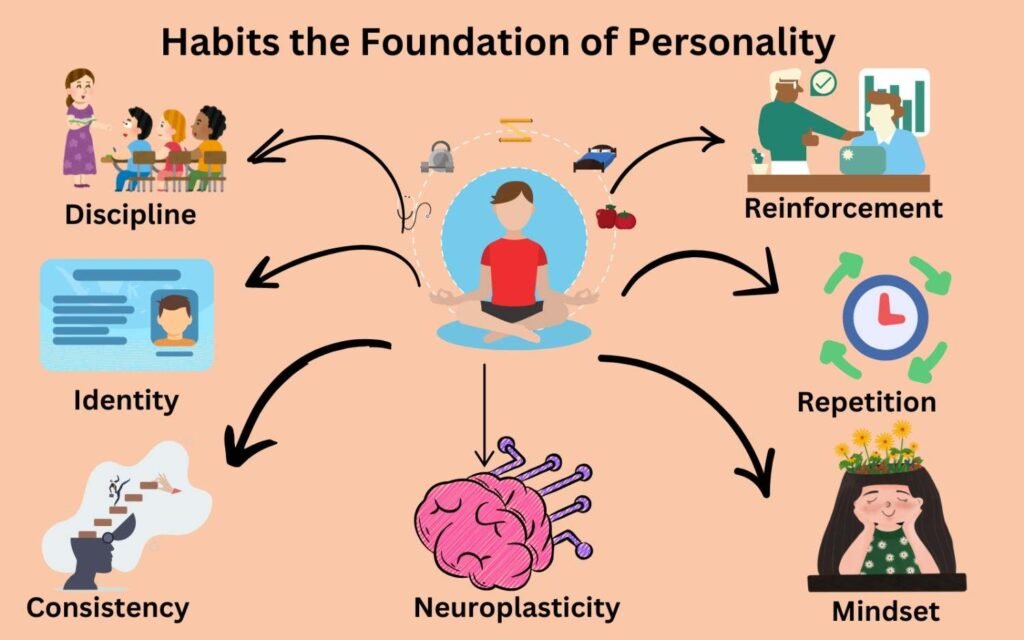
The brain naturally seeks efficiency. To conserve energy, it automates repetitive actions into neural pathways—a process housed within the basal ganglia. In The Power of Habit, researchers and writers note that every habit follows a neurological loop: a cue (trigger), a routine (behavior), and a reward.
When trying to master building healthy habits, people often focus entirely on the routine while ignoring the cues and rewards that drive the loop. Understanding this mechanism explains why fighting an established behavioral system through sheer force feels so exhausting.
Core Psychological Principles of Lasting Behavior Change
Achieving sustainable behavior change requires grounding your goals in psychological science and personal alignment.
- Value-Driven Motivation: True consistency stems from internal alignment. As Bryant Clayton, PsyD, a staff psychologist at The Menninger Clinic, notes, motivation fluctuates, but tying an action to your core values provides a deeper reason to keep going.
- Friction Reduction: The brain favors the path of least resistance. Lowering the barrier to entry—such as laying out workout clothes the night before—eliminates micro-decisions that lead to procrastination.
- Identity Shifts: Instead of focusing purely on outcomes (e.g., “I want to lose 10 pounds”), focus on identity-based habits (“I am someone who prioritizes daily movement”).
- The Power of Self-Compassion: Treating setbacks with curiosity rather than harsh self-critique accelerates recovery after a broken streak.
Step-by-Step Blueprint for Building Healthy Habits
Implementing permanent changes requires a systematic approach that respects your brain’s capacity for adaptation.
| Phase | Strategy | Practical Example |
| 1. Micro-Scoping | Shrink the behavior so it feels effortless to execute, even on low-energy days. | Commit to reading one page of a book or doing a 5-minute stretch instead of an hour-long session. |
| 2. Habit Stacking | Attach the new behavior directly to an established, automatic daily routine. | “After I pour my morning coffee [cue], I will write down three things I am grateful for [routine].” |
| 3. Environmental Design | Alter your physical surroundings to make good choices obvious and bad choices difficult. | Place a water bottle on your desk; hide your phone in another room while working. |
| 4. Progressive Scaling | Gradually increase the intensity or duration only after the baseline behavior is automatic. | Move from a 10-minute daily walk to a 20-minute brisk walk after two consistent weeks. |
Common Pitfalls in Habit Formation and How to Avoid Them
- Setting Vague Intentions: Saying “I want to eat healthier” leaves too many decisions open. Opt instead for specific parameters, such as “I will add a serving of vegetables to my lunch every workday.”
- Chasing Perfectionism: Missing a single day does not erase your progress. Adopting an “all-or-nothing” mindset often causes people to abandon entire routines after one minor slip.
- Ignoring Environmental Cues: Expecting high self-control while keeping junk food on the counter or your smartphone on your desk sets your brain up for friction.
- Overestimating Initial Capacity: Trying to launch five new habits simultaneously overwhelms the nervous system, leading rapidly to burnout.
Related Articles
- Ayurvedic Morning Routine: 10 Daily Habits for Better Wellness
- Morning Walking Benefits: How Many Minutes Should You Walk Daily?
- Ginger Water Benefits: How to Prepare It and When to Drink It
Frequently Asked Questions (FAQs)
How long does it actually take to form a new habit?
While a popular psychological study suggested 21 days, contemporary research indicates that habits take anywhere from 18 to 254 days (an average of about two months) to become automatic, depending on complexity and individual consistency.
Why do I lose motivation after the first week of a new routine?
Initial motivation is an emotional surge driven by novelty. When that excitement fades, your brain encounters structural resistance and falls back on familiar, energy-saving neural patterns.
What is habit stacking and how does it work?
Habit stacking involves linking a brand-new behavior to an established daily action, using the old action as an immediate psychological cue to trigger the new one.
How can I recover after missing several days of my habit?
Acknowledge the gap without self-judgment, identify what caused the disruption, and immediately scale back down to the smallest possible version of the habit to restart momentum.
Is willpower enough to sustain long-term healthy lifestyle habits?
No. Willpower is a finite mental resource that depletes under stress and fatigue; long-term consistency requires environmental design, automated cues, and reduced friction.