
Managing digital infrastructure across multiple websites often leads to administrative friction, security vulnerabilities, and sudden performance degradation. Whether you run a digital agency, oversee multi-brand e-commerce stores, or manage portfolio sites, mastering multiple hosting environments is critical to maintaining uptime, data integrity, and operational efficiency.
Without systematic architecture and governance, relying on ad-hoc setups across fragmented providers creates configuration drift, exposes sites to cross-contamination, and leads to runaway costs.
How to Efficiently Manage Multiple Hosting Accounts
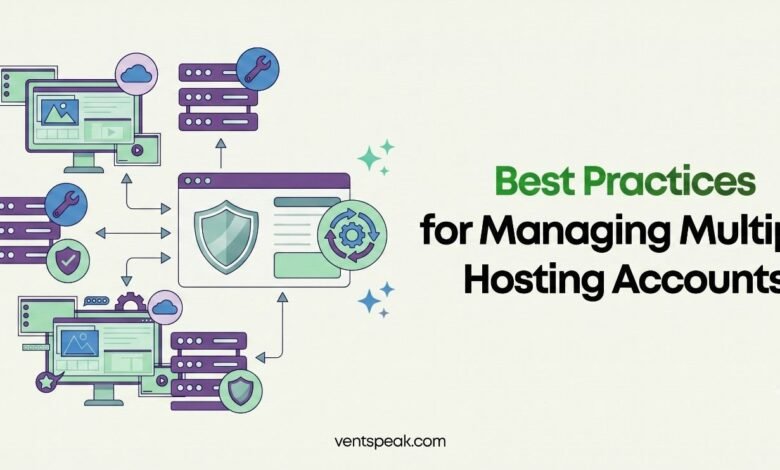
Managing multiple hosting setups effectively requires:
- Centralizing Access and Monitoring: Use unified management platforms or single sign-on (SSO) alongside centralized uptime, APM, and SSL monitoring.
- Enforcing Strict Environmental Isolation: Prevent cross-site infections by running websites in separate cPanel/WHM accounts, Linux user pools, or containerized sandboxes (Docker/LXC) rather than packing addon domains into a single shared root.
- Automating Backups and Maintenance: Store daily encrypted off-site backups (3-2-1 rule) and automate core/plugin updates via staging environments.
- Standardizing the Stack: Keep server runtimes (PHP versions, database engines, caching layers) uniform across all accounts to reduce debugging overhead.
Key Architectural Approaches for Multi Hosting
Before configuring servers, establish the right infrastructure model for your operational requirements. The three primary models for handling multiple web hosting needs are:
1. Addon Domains on a Single Shared Account
In this model, a single shared hosting plan uses multiple domain hosting features to run several sites from subdirectories within one document root.
- When to use: Low-traffic personal hobby sites or static test pages.
- Drawback: Zero security isolation. If a vulnerability in one site is exploited, malicious scripts can traverse directories to compromise every other site sharing that file system.
2. Reseller Hosting (WHM / cPanel / Plesk Multi-Tenant)
Reseller hosting allocates a separate control panel account for each site, sandboxed via OS-level tools like CloudLinux CageFS.
- When to use: Agencies and freelancers looking to host multiple websites for clients without managing raw server kernels.
- Advantage: Each site receives dedicated resource quotas (CPU, RAM, I/O limits), its own user credentials, and isolated database privileges.
3. Cloud VPS and Multi-Cloud Deployments
Here, agencies orchestrate multiple hosting services across virtual private servers or separate cloud providers (such as AWS, Google Cloud, DigitalOcean, or specialized platforms).
- When to use: High-traffic e-commerce, applications with custom stack requirements, or companies mitigating single-provider downtime.
- Advantage: Dedicated compute power, horizontal scalability, and full root access.
Comparing Multi-Hosting Management Approaches
| Hosting Strategy | Isolation Level | Resource Control | Management Complexity | Best For |
| Addon Domains (Single Account) | Very Low (Shared user/filesystem) | None (Sites compete for pool) | Low | Personal testing, static sites, micro-blogs |
| Reseller Multi-Tenant (WHM/Plesk) | High (CloudLinux/CageFS isolated) | Hard quotas per account | Moderate | Design agencies, client portfolios |
| Dedicated Multi-VPS / Containers | Complete (Kernel or Container namespace) | Guaranteed dedicated allocation | High (Requires sysadmin/DevOps) | SaaS apps, high-volume e-commerce |
| Multi-Provider Cloud Strategy | Absolute (Disparate networks & regions) | Dynamic autoscaling | Very High | Enterprise redundancy, disaster recovery |
Core Best Practices for Managing Multiple Hosting Providers
Operating infrastructure across multiple hosting providers demands systematic oversight to avoid security breaches and operational overhead.
1. Enforce True Account & File Isolation
Never host multiple production sites under a single system user.
- On multi-tenant servers, assign each project a distinct Linux user and database user with permissions set to 750 or 710 on root directories.
- On shared systems, ensure the host utilizes kernel virtualization such as CloudLinux LVE to contain memory or CPU spikes within a single tenant.
- If leveraging containerized instances (Docker, LXC), maintain strict volume separation and least-privilege networking policies.
2. Centralize Authentication and Access Management
Logging into dozens of disparate control panels increases credential leakage risks.
- Mandate Multi-Factor Authentication (MFA/2FA) across all server dashboards, registrar accounts, and SSH connections.
- Use an enterprise password manager with role-based access control (RBAC) so team members only access environments designated for their workflows.
- Replace password-based SSH access with Ed25519 SSH keys configured via a centralized bastion host or access gateway.
3. Standardize Server Stacks and Configurations
Inconsistent environments across multiple hosting accounts complicate debugging.
- Standardize on fixed LTS runtime baselines (e.g., PHP 8.2/8.3, MySQL 8.0/MariaDB 10.11).
- Maintain standardized server configuration templates (nginx.conf, php.ini, object-caching rules via Redis) to make behavior identical between staging and production.
- Use configuration management tools like Ansible or Terraform if managing fleet deployments across raw cloud VPS instances.
4. Establish an Automated 3-2-1 Backup Pipeline
Never rely exclusively on a web host’s internal backup system. If an account is suspended or a data center experiences hardware failure, internal snapshots become inaccessible.
- 3 Copies: The live site, one local snapshot, and one off-site replica.
- 2 Media Types: Local fast-restore storage and independent object storage (e.g., AWS S3, Wasabi, Backblaze B2).
- 1 Off-Site Location: Physically separated from the origin hosting provider.
- Run test restorations quarterly to ensure snapshot archives restore cleanly.
5. Implement Unified Performance and Uptime Monitoring
Checking sites manually is impractical when handling multiple website hosting operations.
- External Uptime Checks: Use synthetic monitoring tools to ping HTTP/HTTPS endpoints globally at 1-minute intervals.
- Resource Telemetry: Track CPU, memory consumption, I/O wait, and disk usage across servers via unified dashboards like Prometheus, Grafana, or Datadog.
- SSL Expiration Tracking: Monitor TLS certificates automatically to catch failed ACME/Let’s Encrypt renewals before browsers flag security warnings.
Common Pitfalls in Multi Hosting (And How to Avoid Them)
- The Addon Domain Trap: Treating multiple domain hosting as a cost-cutting silver bullet. A single unpatched plugin on one site can compromise all sites within the same file structure.
- Unmonitored Auto-Renewals and Card Expirations: Spreading accounts across multiple providers leads to missed invoices, domain expirations, and unexpected downtime. Consolidate billing alerts into a central financial tracker.
- Orphaned Test Installations: Staging copies, dev subdomains, and forgotten demo databases consume disk space and present unpatched attack vectors. Enforce automated cleanup policies for testing environments.
- DNS Fragmentation: Managing DNS records across multiple disparate registrars and hosts leads to misconfigurations. Route domain nameservers through a centralized, high-performance DNS layer (like Cloudflare or Route 53) to retain unified control over routing, edge caching, and Web Application Firewalls (WAF).
Future Trends in Multi-Site and Multi-Provider Hosting
Managing multi hosting fleets continues to shift away from manual cPanel administration toward programmable infrastructure:
- Edge Compute and Decoupled Frontends: Jamstack architectures and serverless runtimes (Cloudflare Workers, Fastly Compute, Vercel) abstract traditional server management by deploying static assets and edge workers across globally distributed nodes.
- Container Orchestration (Kubernetes/Nomad): Multi-tenant agency hosting increasingly runs on lightweight Kubernetes distributions (like K3s), giving engineers auto-healing infrastructure, instant rollbacks, and zero-downtime rolling deploys.
- AI-Assisted Sysadmin Telemetry: Next-generation control systems leverage machine learning models to detect abnormal traffic patterns, predict server resource exhaustion, and automatically patch zero-day CMS exploits before they propagate.
Related Articles
- What Is Container Hosting? Docker and Kubernetes Simplified
- Disaster Recovery Planning for Website Hosting
- How to Improve Website Reliability with Redundant Servers
Frequently Asked Questions (FAQs)
Can I host multiple websites on one shared hosting account?
Yes, if your provider supports addon domains. However, this is only recommended for low-traffic or testing sites. Shared account sites share the same file system, execution user, and server resources, meaning a breach or resource spike on one site directly impacts all others.
What is the difference between multiple hosting accounts and reseller hosting?
Individual multiple hosting accounts are isolated services purchased separately across one or more providers. Reseller hosting provides a single master dashboard (like WHM) where you provision, manage, and isolate separate cPanel accounts with custom resource limits under a unified billing umbrella.
How do I prevent security cross-contamination across multiple sites?
Isolate each website into its own Linux system user or virtualized tenant environment. Utilize CloudLinux CageFS, containerization (Docker), or distinct VPS instances so compromised code in one web directory cannot access the files or databases of neighboring sites.
How do I manage DNS when using multiple hosting providers?
Use an independent, centralized DNS provider (such as Cloudflare, AWS Route 53, or NS1) instead of pointing nameservers directly to individual web hosts. This lets you manage routing, A/CNAME records, and edge proxy rules from a single interface regardless of where the servers reside.
When should I migrate from a shared multi-hosting account to a VPS?
Upgrade to a VPS or reseller environment when total monthly traffic exceeds shared hosting resource caps, CPU or memory throttling triggers frequent 503 errors, or you host client websites that require strict data security and compliance isolation.
Scaling Your Multi-Hosting Infrastructure
Mastering multiple hosting environments comes down to treating your servers as a structured fleet rather than a loose collection of login portals. Centralize your management layer, enforce strict tenant isolation, automate remote backups, and use unified monitoring. By standardizing runtime stacks and taking control of your DNS, you eliminate administrative complexity, protect client sites from cross-contamination, and ensure consistent performance across every site you manage.