
The rules of B2B software have been completely rewritten. For over two decades, the playbook for building a successful software-as-a-service (SaaS) company was straightforward: build a reliable system of record, sell per-seat licenses, and scale a human-driven go-to-market (GTM) engine. Today, that playbook is obsolete.
The shift toward AI in SaaS is no longer about slapping a generic chatbot onto an existing product interface. We have entered the era of AI-powered SaaS and true AI-Native SaaS, where autonomous agents execute entire workflows, software acts as a system of execution rather than a passive database, and seat-based pricing faces structural collapse. For modern tech founders, navigating this AI transformation in SaaS requires fundamental re-architecture.
What is AI-Native SaaS?
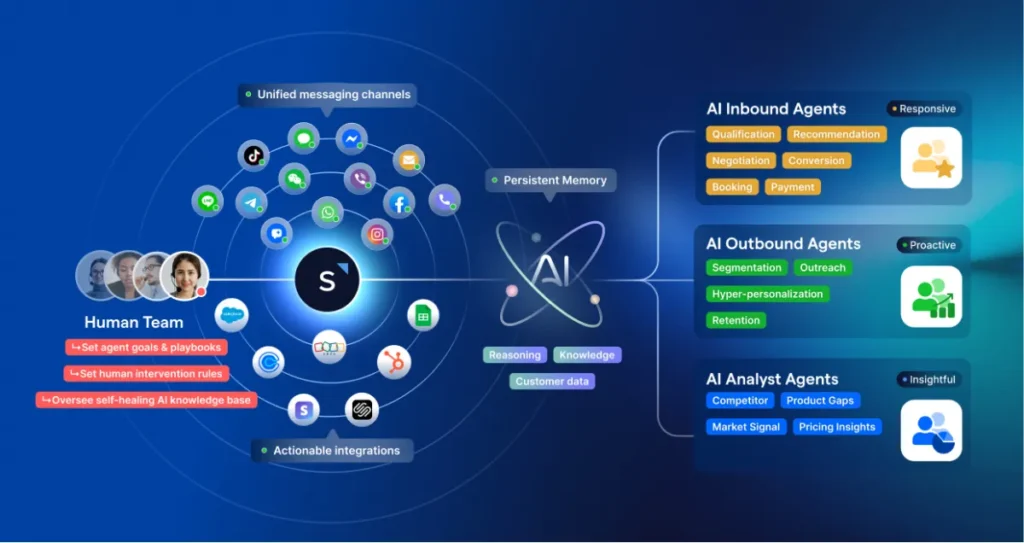
AI-native SaaS refers to software applications built from the ground up around artificial intelligence and autonomous agents, rather than legacy cloud frameworks retrofitted with superficial AI features. While traditional SaaS helps humans do work, AI-native SaaS uses autonomous workflows to finish the work end-to-end—fundamentally disrupting traditional pricing models, product architectures, and team structures.
1. Traditional SaaS vs. AI-Native SaaS: The Great Architectural Shift
To understand why investors and operators are shifting capital toward AI for SaaS companies, you must first examine the structural chasm separating legacy software from next-generation platforms.
Traditional SaaS products are built around human input loops: a user logs in, navigates a complex dashboard, enters data, and clicks buttons. In contrast, AI-native platforms treat intelligence and autonomy as the core operating system.
| Feature | Traditional SaaS | AI-Native SaaS |
| Core Architecture | Relational databases & deterministic UI flows | LLM orchestration layers & autonomous agents |
| Primary Function | System of record (storing data) | System of execution (taking autonomous action) |
| Pricing Model | Per-seat / Per-user subscription | Usage-based, token-consumption, or outcome-driven |
| User Interaction | Manual clicking, form filling, report building | Natural language prompts, exception handling, approval gates |
2. Core Drivers Fueling the AI Transformation in SaaS
The rapid acceleration of AI in SaaS is propelled by three distinct market forces that every founder must factor into their roadmap:
- The Shift to Agentic Workflows: Software has evolved from recommending actions to executing multi-step business processes autonomously.
- The Collapse of Per-Seat Logic: When AI agents replace the need for large operational teams (such as SDRs or tier-one support reps), selling software by human “seats” creates a misaligned incentive structure.
- The Rise of Vertical AI: Enterprise buyers no longer want horizontal tools that require heavy customization. They demand vertical AI solutions pre-trained on industry-specific data, regulations, and proprietary workflows.
3. Practical Playbook: How Founders Can Adapt
Adapting your startup to survive and thrive in the AI SaaS landscape demands a tactical pivot across product, pricing, and operations.
Step 1: Redesign Workflows Around Autonomous Agents
Stop designing features that merely draft text for humans to review. Build workflows where agents complete the loop entirely, allowing humans to step in strictly as approvers or exception handlers.
Step 2: Transition to Consumption or Outcome-Based Pricing
Because AI reduces the number of human users required to accomplish a task, per-seat pricing penalizes efficiency. Transition your monetization strategy toward usage metrics, API calls, completed workflows, or direct business outcomes.
Step 3: Prioritize Built-In AI Governance and Security
Enterprise buyers are heavily scrutinizing data privacy, prompt leakage, and compliance. Give every deployed AI agent its own granular identity, strict least-privilege API access, and an unalterable audit log.
Best Practices and Common Mistakes to Avoid
Best Practices
- Expose Clean APIs: AI agents interact through backend services rather than graphical user interfaces. Ensure your product is API-first.
- Start Narrow: Choose one high-friction, repetitive task within your niche and master end-to-end automation for that specific use case before expanding.
Common Mistakes to Avoid
- The “Feature Trap”: Adding a superficial chat wrapper to an aging codebase and expecting it to command enterprise pricing.
- Ignoring FinOps: Underestimating inference and token costs can quickly sink your gross margins as customer usage scales.
Related Articles
- 10 Best AI Tools in 2026: The Ultimate Guide
- Top Workflow Automation Software for Growing Companies
- 7 SaaS Security Best Practices: How AI Strengthens Cloud Application Protection
Conclusion
The transition toward AI-native SaaS marks the most significant evolution in enterprise technology history. Founders who cling to legacy per-seat models and manual user interfaces risk losing market share to agile competitors. By embracing autonomous workflows, shifting toward usage-based monetization, and prioritizing enterprise-grade governance, modern tech companies can build durable, highly scalable category leaders for the AI era.
Frequently Asked Questions (FAQs)
1. Is traditional SaaS dead in the age of AI?
No, SaaS is not dead, but the traditional way of winning through static feature checklists and per-seat pricing is rapidly fading. Software that fails to evolve into an autonomous system of execution risks becoming obsolete.
2. How should early-stage startups price AI-powered SaaS products?
Founders are increasingly moving away from per-seat subscriptions toward usage-based, token-metered, or outcome-aligned pricing models that scale directly with the value delivered by autonomous agents.
3. What is the difference between AI-enabled and AI-native SaaS?
AI-enabled SaaS refers to legacy software that bolts on secondary AI features (like a summary button or chatbot). AI-native SaaS is architected from inception around machine intelligence and autonomous execution loops.
4. How do enterprise buyers evaluate AI security in SaaS?
Enterprise buyers look for built-in governance frameworks, robust data isolation, granular role-based access for AI agents, and transparent audit logging to prevent compliance failures.
5. Why are vertical AI solutions outperforming horizontal tools?
Vertical AI solutions come pre-integrated with industry-specific data models, compliance guardrails, and niche workflows, allowing them to deliver immediate, contextual value without heavy user configuration.