
Establishing a home practice with foundational yoga poses is an effective, low-impact strategy to enhance joint mobility, core stability, and autonomic nervous system regulation. Research highlights that regular yoga practice reduces systemic inflammation markers and mitigates chronic stress by downregulating the sympathetic nervous system.
Top 5 Beginner Yoga Poses
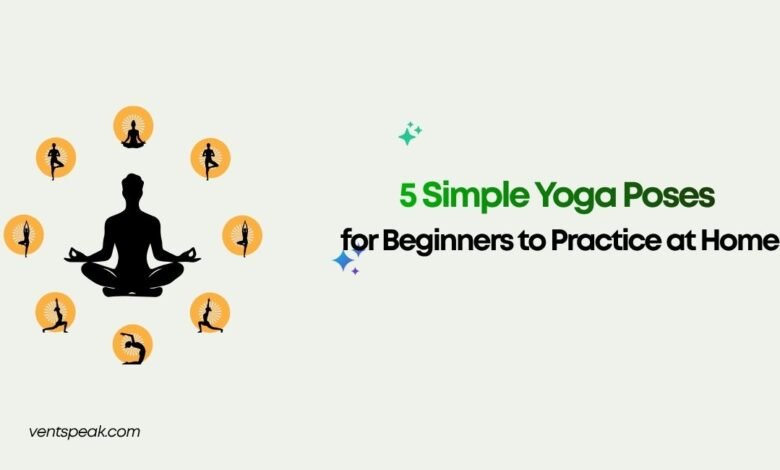
For a balanced, full-body home routine, practice these five essential postures in sequence:
- Mountain Pose (Tadasana): Establishes postural alignment, balance, and proprioception.
- Child’s Pose (Balasana): Restores the nervous system and gently stretches the lower back and hips.
- Downward-Facing Dog (Adho Mukha Svanasana): Decompresses the spine while building upper-body and hamstring length.
- Cat-Cow Stretch (Marjariasana-Bitilasana): Improves spinal flexibility and core coordination.
- Corpse Pose (Savasana): Promotes deep physiological relaxation and somatic integration.
Key Highlights: Beginner Posture Matrix
| Yoga Pose | Target Muscle Groups | Primary Health Benefit | Common Mistake to Avoid |
| Mountain Pose (Tadasana) | Quadriceps, core, postural stabilizers | Improves standing balance & posture | Locking the knees out |
| Child’s Pose (Balasana) | Latissimus dorsi, glutes, hip flexors | Downregulates stress & calms the mind | Over-stretching tight hips |
| Downward Dog (Adho Mukha Svanasana) | Hamstrings, calves, shoulders, core | Decompresses spine & builds upper strength | Rounding the lower back |
| Cat-Cow Stretch (Marjariasana) | Erector spinae, rectus abdominis, neck | Enhances intervertebral mobility | Overextending the neck upward |
| Corpse Pose (Savasana) | Full-body relaxation (passive) | Reduces cortisol & blood pressure | Shallow breathing or mental tension |
Step-by-Step Guide: 5 Essential Yoga Poses
1. Mountain Pose (Tadasana)
- Execution: Stand with big toes touching, heels slightly apart. Ground through all four corners of your feet. Engage your quadriceps, tuck your pelvis slightly, roll your shoulders back, and extend through the crown of your head.
- Biomechanical Benefit: Serves as the blueprint for all standing postures, reinforcing structural alignment.
2. Child’s Pose (Balasana)
- Execution: Kneel on the floor, touch your big toes together, and sit on your heels. Separate your knees hip-width apart, exhale, and lay your torso down between your thighs. Extend your arms forward with palms flat on the mat.
- Biomechanical Benefit: Provides gentle axial extension for the spine while reducing hip capsule tightness.
3. Downward-Facing Dog (Adho Mukha Svanasana)
- Execution: Start on all fours. Press firmly into your palms, tuck your toes, and lift your knees off the floor, reaching your seat toward the ceiling to form an inverted “V”. Keep a subtle bend in your knees if your hamstrings feel tight.
- Biomechanical Benefit: Strengthens shoulder girdle stabilizers while lengthening the posterior chain.
4. Cat-Cow Stretch (Marjariasana-Bitilasana)
- Execution: Begin on hands and knees in a neutral tabletop position. Inhale into Cow Pose by dropping the belly, lifting the chest, and tilting the pelvis up. Exhale into Cat Pose by rounding the spine toward the ceiling and tucking the chin to the chest.
- Biomechanical Benefit: Synchronizes movement with breath while promoting segmental spinal articulation.
5. Corpse Pose (Savasana)
- Execution: Lie flat on your back with legs comfortable distance apart and arms resting alongside your body, palms facing up. Close your eyes, release all muscular tension, and allow your natural breath rhythm to take over for 5–10 minutes.
- Biomechanical Benefit: Shifts the body into a parasympathetic state to consolidate neuromuscular learning.
Read More Blogs:
Bhramari Pranayama Benefits: How Humming Breath May Help You Relax
How Mindfulness Can Improve Your Focus and Memory
Best Foods for Brain Health and Mental Clarity
A Complete Wellness Guide for 2026: Mental, Physical, and Nutritional Health
Components of Wellness: Why Each One Matters for Your Well-Being
10 Signs Your Body Needs More Nutrition and How to Fix Them
Kapalbhati Pranayama: Benefits, Steps, and Precautions
Safety and Modifying Your Home Practice
- Listen to Pain Signals: Sharp or pinching sensations indicate joint impingement—back off immediately.
- Use Props Generously: Utilize yoga blocks under hands in Downward Dog or a folded blanket under knees during Cat-Cow to reduce joint strain.
- Prioritize Form Over Depth: Maintaining a neutral spine is significantly more beneficial than forcing a deeper stretch with compromised posture.
Frequently Asked Questions
How long should beginners hold each yoga pose?
Hold active poses like Mountain or Downward Dog for 3 to 5 full breath cycles (about 20–30 seconds). Restorative poses like Child’s Pose or Corpse Pose can be held comfortably for 1 to 5 minutes.
Do I need a yoga mat to practice at home?
While a yoga mat provides essential traction and cushioning for joint comfort, beginners can start on a clean carpeted surface or non-slip floor.
Can practicing simple yoga poses help with low back pain?
Yes. Gentle poses like Cat-Cow and Child’s Pose help mobilize the lumbar spine and relieve tight spinal extensors, but consult a physical therapist if you have acute spinal disk injuries.