
5 Best Web Hosting Providers in 2026: Features, Pricing, and Expert Reviews


Choosing the best web hosting provider is the most critical infrastructure decision you will make for your digital presence. In 2026, web hosting has evolved past basic server space. Modern architecture demands specialized server technologies like LiteSpeed Enterprise, NVMe storage matrices, and edge-delivery caching layers designed to pass Google’s strict Core Web Vitals thresholds and power AI-driven search discoveries.
Whether you are launching a startup blog or scaling a high-traffic e-commerce store, your choice directly dictates your SEO visibility, user experience, and baseline security. This comprehensive guide reviews the top web hosting services in india and global markets to help you deploy your site on the ultimate infrastructure stack.
The Best Web Hosting Providers in 2026
If you need a fast, data-backed decision for an upcoming deployment, this structured summary outlines the top web hosts based on real-world uptime monitoring, time-to-first-byte (TTFB) testing, and hardware infrastructure.
- Hostinger (Best Overall): Exceptional performance utilizing LiteSpeed technology, unthrottled global edge caching, and localized payment processing. Ideal for budget-conscious sites, bloggers, and scaling brands.
- ScalaHosting (Best for Cloud VPS & E-commerce): Fully managed cloud infrastructure with dynamic resource scaling, optimized for WooCommerce and heavy multi-tenant web applications.
- SiteGround (Best Premium WordPress Hosting): Elite server isolation, custom server-side caching mechanics, and highly responsive developer environments.
- Cloudways (Best Managed Cloud Explorer): Managed abstraction layer allowing deployments across AWS, Google Cloud, and DigitalOcean with single-pane control.
- KnownHost (Best for Transparent Pricing & Support): High-frequency bare-metal hardware stacks with non-predatory, flat-rate renewal models.
Top 5 Web Hosting Service Providers Reviewed
To find the absolute best hosting provider in india and globally, we purchased entry-level and mid-tier plans from major market contenders. Every platform was benchmarked using live traffic simulations, localized TTFB checking across Indian and international POPs (Points of Presence), and actual customer support interaction loops.
1. Hostinger – Best Overall Performance & Value

Hostinger continues to dominate the best shared hosting in india category because it pairs ultra-low introductory rates with ultra-high-performance server software.
Instead of old, slow Apache setups, Hostinger utilizes LiteSpeed Web Server (LSWS) across its fleet. LiteSpeed processes PHP processing demands and handles concurrent connections up to 40 times better than traditional architectures. It also natively leverages LSCache, storing fully compiled page files directly in the server memory for instant responses.
- Core Infrastructure: 100% NVMe storage matrices, HTTP/3 transport layers, and custom hPanel administration dashboards.
- Indian Server Optimization: Data centers in Mumbai ensure sub-100ms TTFB across the Indian subcontinent, fully supporting UPI and local credit cards.
- The Bottom Line: Hostinger’s Business Plan is a masterclass in affordable performance, providing an ideal launchpad for growth without deep developer experience.
2. ScalaHosting – Elite Managed Cloud VPS

For revenue-sensitive commercial sites or fast-growing platforms, traditional shared architectures can present serious multi-tenant security risks. ScalaHosting resolves this by providing isolated, fully managed Cloud VPS nodes at shared-hosting price thresholds.
ScalaHosting uses their custom SPanel, which completely eliminates the costly licensing overhead of cPanel. This savings allows them to allocate higher-grade hardware resources—including fully customizable CPU and RAM counts—to your virtual private space.
- Core Infrastructure: Native OpenLiteSpeed integration, off-site daily snapshots, and isolated resource allocation.
- Security Stack: SShield cybersecurity layer monitoring traffic in real-time to block malicious code injections before they breach your database.
- The Bottom Line: If your site relies on consistent transactions or handles heavy user databases, ScalaHosting’s managed cloud nodes deliver superior infrastructure isolation.
3. SiteGround – Premium Managed WordPress Hosting

SiteGround is a premier web host officially recommended by WordPress.org. Built entirely on top of Google Cloud Infrastructure, SiteGround takes standard server capabilities and optimizes them with high-end, proprietary software tuning.
Their standout feature is a custom-engineered Centralized PHP architecture, which processes incoming server requests significantly faster than standard configurations. Coupled with multi-layered SuperCacher environments, page assets load almost instantly.
- Core Infrastructure: Google Cloud platform nodes, automated staging environments, and native Git integration.
- Developer Support: On-demand data backups, granular staging links, and automated core updates with built-in script vulnerability scanning.
- The Bottom Line: While renewal rates are higher, SiteGround remains an unmatched premium choice for agencies and enterprises demanding top-tier code execution.
4. Cloudways – Flexible Multi-Cloud Abstraction
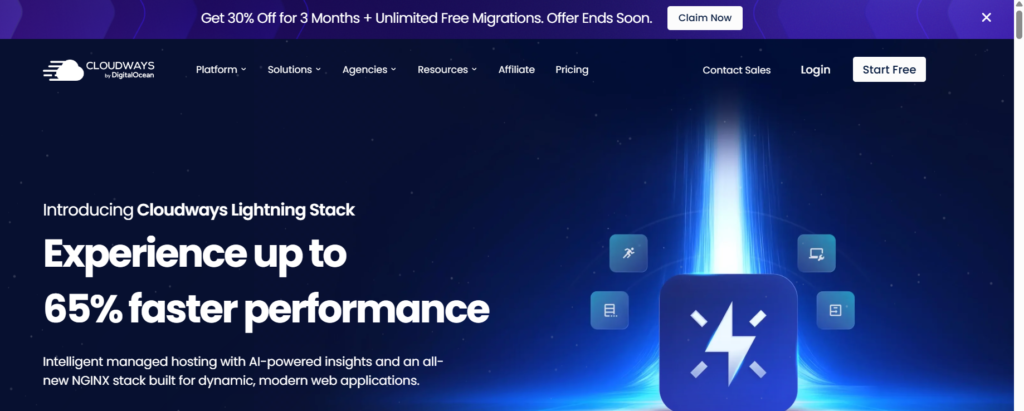
Cloudways changes the traditional hosting workflow. Instead of selling you their own physical data servers, they act as an intelligent management layer over top-tier cloud networks: DigitalOcean, AWS, and Google Cloud.
This gives you raw cloud-computing performance without needing complex system administration skills. Cloudways handles all server provisions, OS updates, and network firewalls through a clean visual dashboard.
- Core Infrastructure: Cloud server options, Redis database caching, and dedicated application isolation.
- Elastic Scalability: Scale server RAM and CPU processing power with a single click to manage viral traffic spikes effortlessly.
- The Bottom Line: Cloudways provides the perfect architecture for technical developers, SaaS startups, and expanding corporate networks.
5. KnownHost – Best for Transparent Pricing & Enterprise Support

KnownHost is a top choice within developer communities due to its strict focus on high-performance hardware and straightforward, honest pricing. They avoid the standard industry trap of offering cheap signup rates only to triple the price upon renewal.
Running entirely on high-frequency enterprise CPUs and NVMe solid-state storage, KnownHost features excellent load-handling capabilities. Their managed stacks include premium licenses like LiteSpeed, Imunify360 security protection, and cPanel out of the box.
- Core Infrastructure: High-frequency processors, direct cPanel interfaces, and integrated Imunify360 protection.
- True Expert Support: Technical support tickets are answered directly by tier-2 and tier-3 system engineers, avoiding basic, scripted call-center workflows.
- The Bottom Line: KnownHost is ideal for businesses that want reliable server performance, predictable renewal bills, and expert server engineering support.
Head-to-Head Architectural Comparison
Choosing the best web hosting option requires matching server capabilities against your target audience. This matrix breaks down the technical specs, pricing tiers, and primary use cases for the top five providers.
| Hosting Provider | Starting Price (Approx) | Base Server Architecture | Caching Layer | Target Audience / Use Case |
| Hostinger | ₹149 – ₹249 / mo | LiteSpeed Enterprise + NVMe | LSCache Native | Beginners, Bloggers, Web Hosting India |
| ScalaHosting | $12.95 / mo | Managed Cloud VPS / SPanel | OpenLiteSpeed / Custom | Growing E-commerce, Scalable Web Apps |
| SiteGround | $3.95 / mo | Google Cloud + Custom PHP | SuperCacher (3-Layer) | Agencies, High-End WordPress Projects |
| Cloudways | $11.00 / mo | Multi-Cloud (DigitalOcean/AWS) | Redis + Varnish Object | Developers, Tech Startups, SaaS |
| KnownHost | $3.50 / mo | High-Frequency cPanel Stacks | LiteSpeed + LSCache | SMBs Seeking Flat-Rate Renewal Pricing |
5 Critical Mistakes to Avoid When Selecting a Web Host
- Falling for Undefined “Unlimited” Claims: No server has unlimited resources. Hosts enforce strict Inode limits (the total number of files on your account) or CPU usage caps. Always read the fine print.
- Ignoring the Renewal Price Jump: Many low-cost web hosting services in india lure buyers with cheap intro rates, then increase prices by 200% to 300% on renewal. Factor the long-term renewal cost into your budget.
- Deploying Sites Too Far From Users: If your main traffic is in Mumbai or Delhi, hosting your site on a server in New York adds significant latency. Always choose a host with a data center close to your target audience.
- Overlooking Automated Backup Systems: Bad plugin updates or file corruptions happen. If your host charges extra for daily off-site backups, a single server issue could wipe out your entire site.
- Skipping Server-Level Caching: Relying solely on heavy WordPress caching plugins strains your database. Always look for native, server-side caching like LiteSpeed or Redis to ensure fast load times.
Future Trends: What Drives Web Hosting in 2026?
The web hosting service provider market is undergoing major shifts driven by AI advancements and greener infrastructure needs.
- AI-Optimized Edge Computing: Modern hosting nodes use machine learning algorithms to predict traffic spikes, dynamically shifting server memory allocations before your site slows down.
- Green Web Hosting: Environmental impact is now an active search engine optimization signal. Top companies like Krystal and GreenGeeks match 300% of their grid power usage with renewable energy credits, making eco-friendly servers a priority.
- GEO & AEO Readiness: Search engines look beyond standard metadata; they prioritize sites that render content instantly. Sub-second TTFB speeds and robust HTTP/3 implementations are crucial for ranking in AI-driven search answer boxes.
Conclusion & Next Steps
Finding the best web hosting option isn’t about chasing the absolute cheapest price—it is about finding the right balance of speed, security, and long-term price transparency. For standard blogs, new portfolio sites, or local business pages, Hostinger offers excellent speed and performance features at a very accessible entry point. If your platform handles heavy databases or sensitive e-commerce payments, upgrading to a managed node like ScalaHosting ensures your site stays stable and isolated.
Take a look at your traffic goals, map out your budget including renewal rates, and pick a platform that positions your site for fast, responsive performance across all modern search networks.
Frequently Asked Questions (FAQs)
What is the difference between Shared Hosting and Cloud VPS?
Shared hosting places hundreds of websites onto one single server partition, sharing all CPU and RAM resources. If one site experiences a massive traffic spike, neighboring sites can slow down. A Cloud VPS isolates your account into its own virtual machine with dedicated resources, guaranteeing stable performance.
Why does server location matter for web hosting in India?
Server location directly dictates network latency. Choosing a web hosting india option with physical servers in hubs like Mumbai or Bangalore ensures data travels the shortest physical distance to local users. This drops your page load speeds down significantly compared to hosting on distant US or European data centers.
Can I migrate my existing website to a new host for free?
Yes, most top-tier providers like Hostinger, ScalaHosting, and SiteGround provide automated or expert-assisted website migrations at zero extra cost. They can move your entire database and file structure without causing site downtime.
What are Inodes in web hosting, and why do they matter?
An Inode represents a single file, folder, email, or database entry on your server account. Even if you have plenty of gigabytes of disk storage left, exceeding your plan’s maximum Inode count will prevent your site from saving new data or receiving emails.
Is a Free SSL Certificate included with modern hosting packages?
Yes, any reputable web hosting service provider must offer free Let’s Encrypt SSL certificates. Avoid any provider that tries to charge an annual fee for basic SSL setup.